
Ask the Archive
Dusty Backlog
“Vent detective, reluctant historian, and keeper of several centuries' worth of dusty ventriloquism history.”
He will not tell you a thing he cannot show you in the file.
Ask him about a performer, a figure, a maker, a theater, a year. He works the whole archive: 151,224 researched facts covering biography, figures, craft and trade practice, plus 28,197 dated newspaper notices running back to 1799.
He will tell you when he does not know. If the archive has not got it, he says so rather than guessing, because a made-up date in a place like this gets quoted elsewhere and turns into history. If you know something he does not, send it in.
About the figure
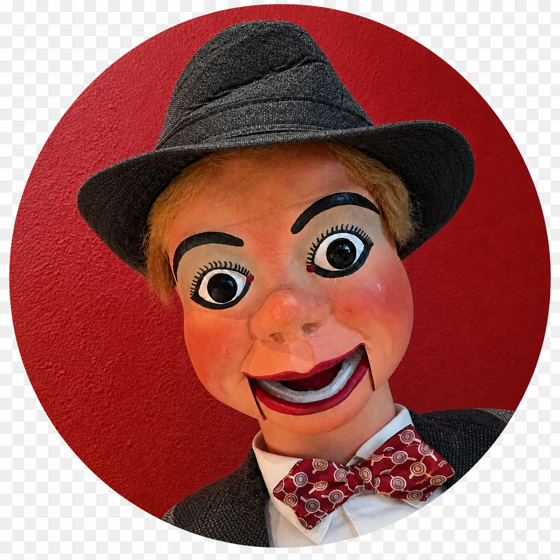
Dusty is a real ventriloquist figure out of Jimmy Vee's collection, and his history is the kind of thing this archive exists to keep straight. The head came from Theodore Mack & Sons of Chicago, furniture builders who turned out a whole line of figures used by most of the very early American ventriloquists. Frank Marshall got his start with them.
He was rebuilt twice, roughly eighty years apart, by the best-known restoration shop of each era. The Willinger auction catalog puts it plainly: “This Mack creation was redone in the 1930's by the workshop of George ‘Pinxy’ Larsen. It was in terrible condition again after years of abuse and was restored to look as he does now by Ray Guyll.” Slot jaw only, which was the standard Mack specification.
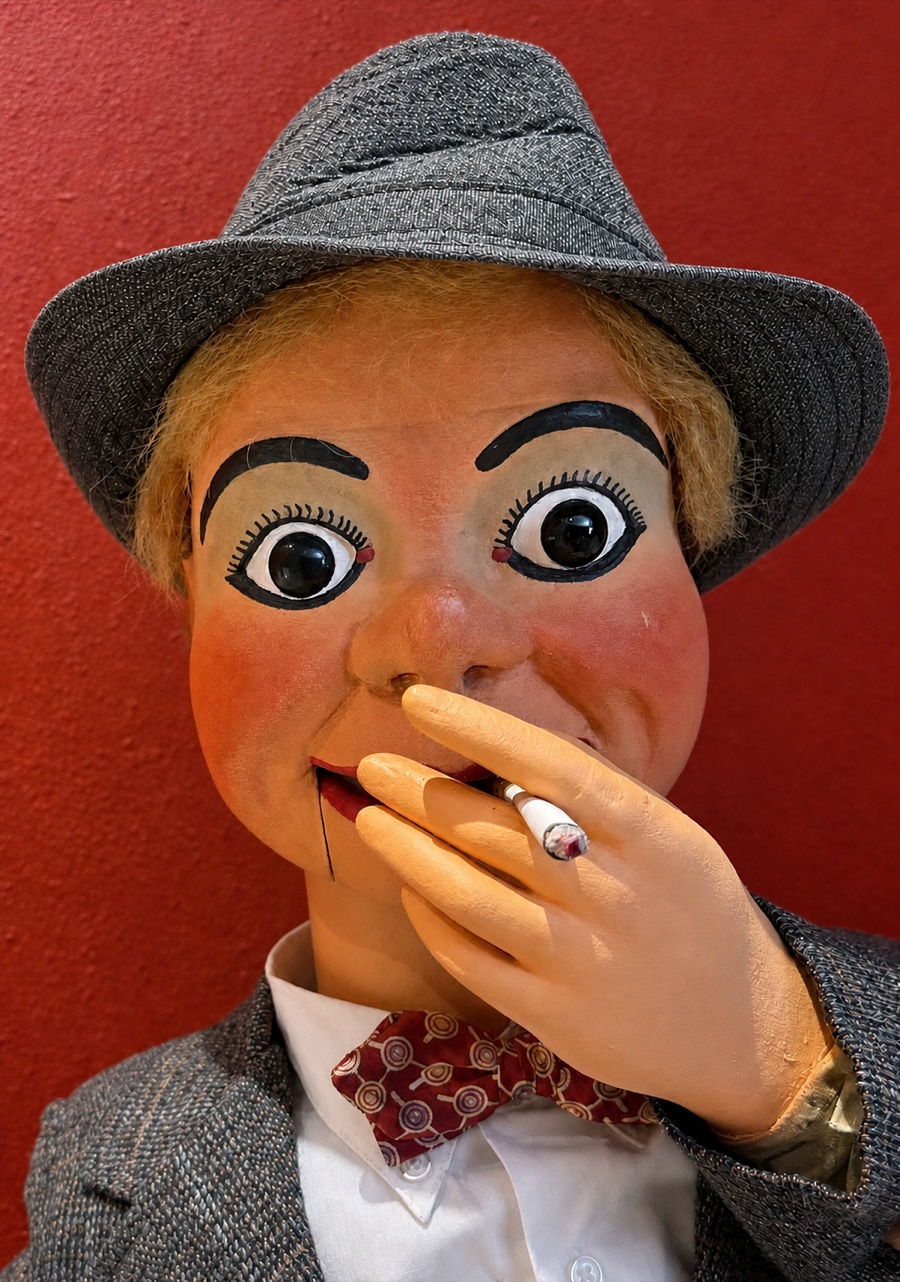
About the cigarette: the fingers are carved apart in a way that holds one exactly, and Jimmy Vee, who owns him, believes the hand was made for it. The archive cannot yet show you that in a source. Nothing we hold describes a hand carved to hold a cigarette, and no maker's list or price sheet in the collection offers one. What the record does show is that smoking was a thing these figures did: Stadelman had Charlie Mack carve Windy Higgins in 1913 and “later had eyelids installed, and a cigarette smoking attachment, and a better wig”, and one Mack in the collection notes runs to “slot jaw, rolling eye winker, smoker and spitter”. Those are mechanisms, not hands. So this is a belief with good company and no proof, and it stays labeled as one until a catalog page or a maker says otherwise.