
Figure maker
Art Sieving
An obscure name and a very good carver. He made architectural work, clocks and a handful of figures.

Art Sieving built maybe ten ventriloquist figures in his entire life, and that count comes from the one man who's held several of them in his own hands.[1] Ten, in a whole lifetime, against a trade where the busiest Chicago and Detroit shops turned out hundreds. Measure the man by volume and he barely shows up on the chart. Measure him by what happened next, and the story flips fast: one of those ten went to a seventeen year old kid who tracked Sieving down through a two line listing in the back of a ventriloquism magazine, and that kid grew up to become the only ventriloquist ever to win a Tony Award.[2] Pull up a chair. The ledger undersells this man completely.
A carver first, a magician on the side
He was born on a farm in central Illinois on November 24, 1902, and spent his adult life in Springfield.[1][3] He started out working for a painting contractor. Somewhere along the way he became a professional magician and ventriloquist instead, and when he couldn't find figures on the market that satisfied him, he picked up carving tools and started building his own.[3] The carving took over from there. He did architectural work and ornamental clocks alongside the odd ventriloquist figure, "even a few," in the words of one auction catalog that handled his work decades later.[4] His 1942 draft card lists his employer as WTAX, Springfield's radio station, so put broadcaster on the resume too.[1]
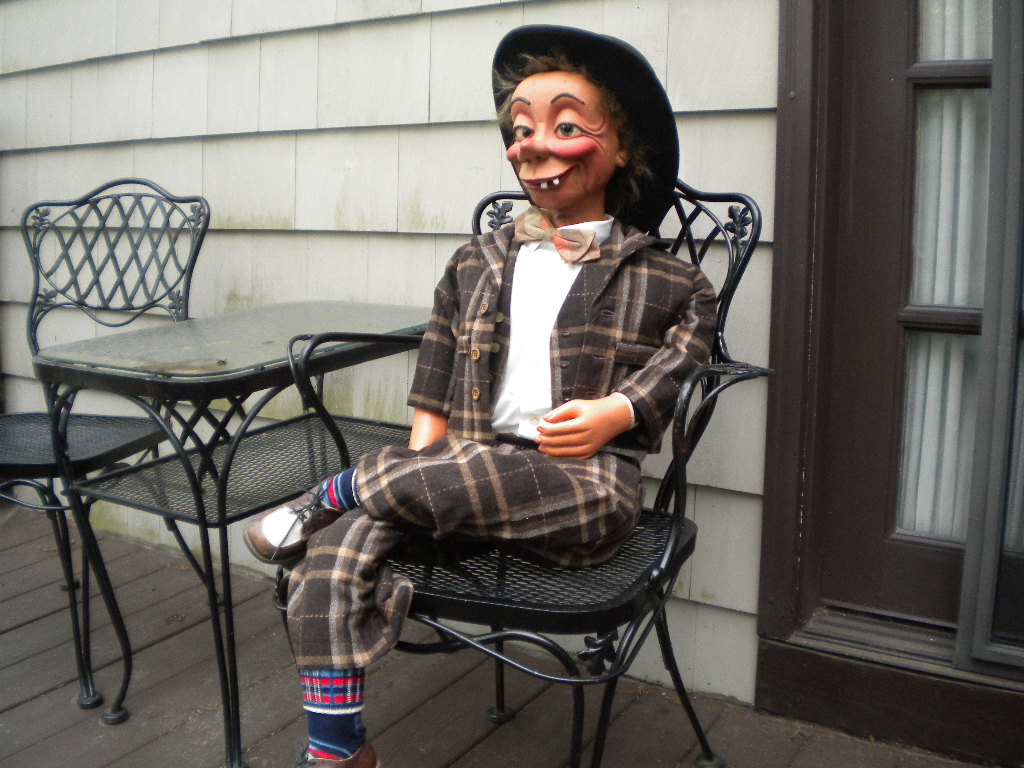
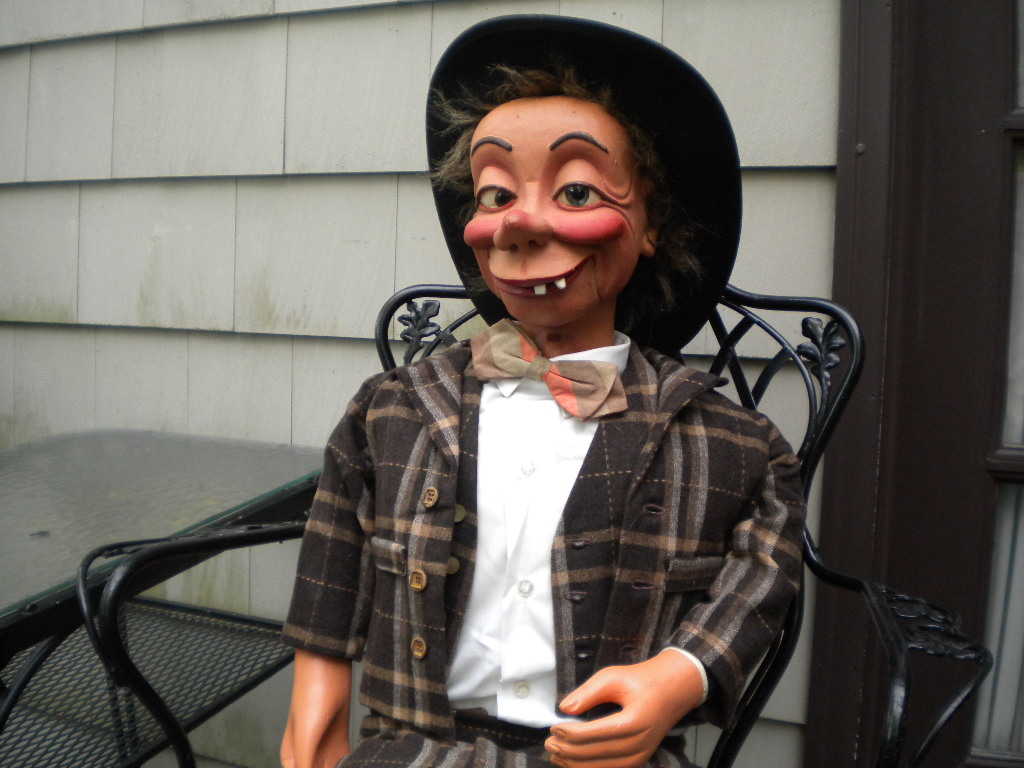
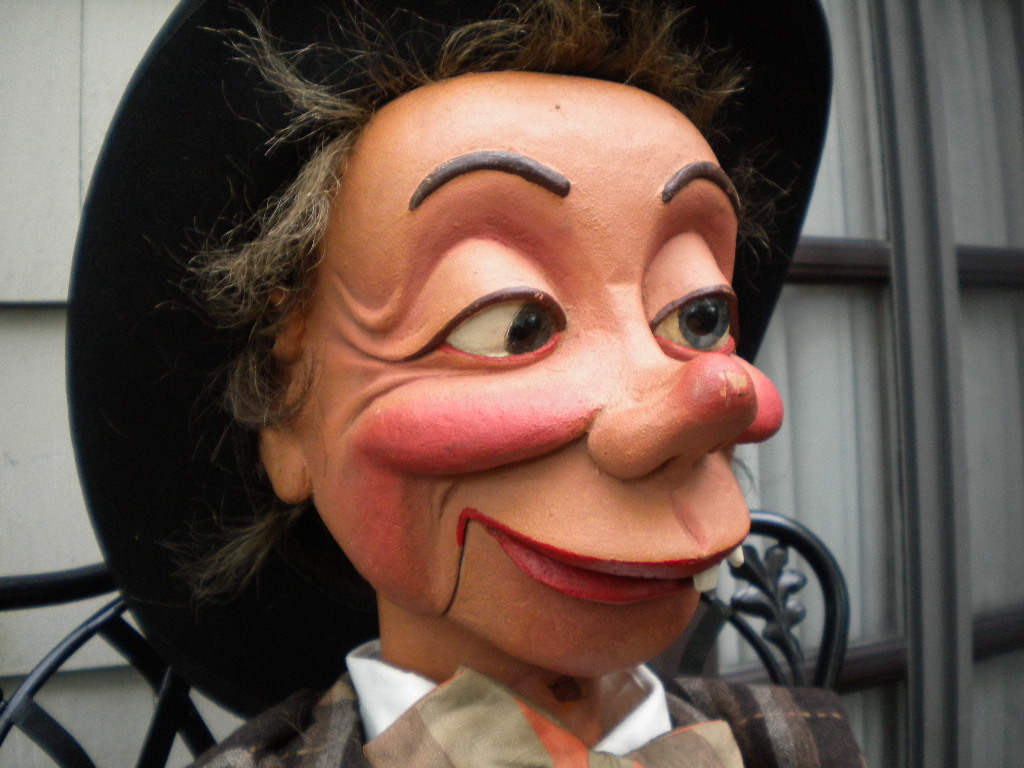
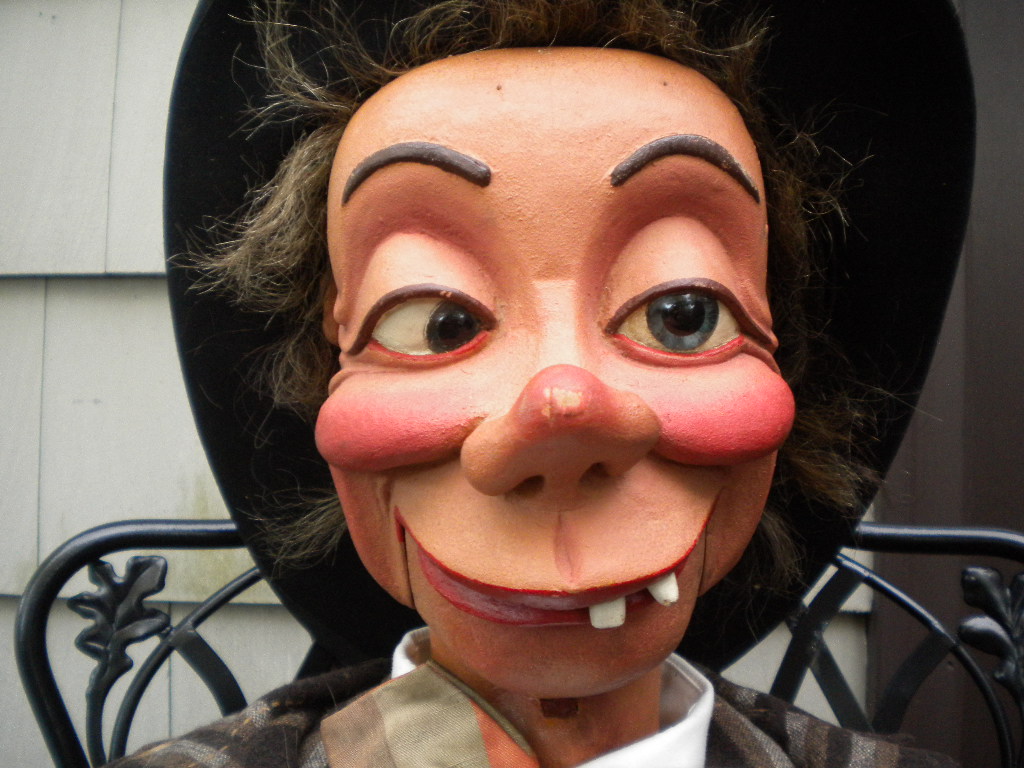
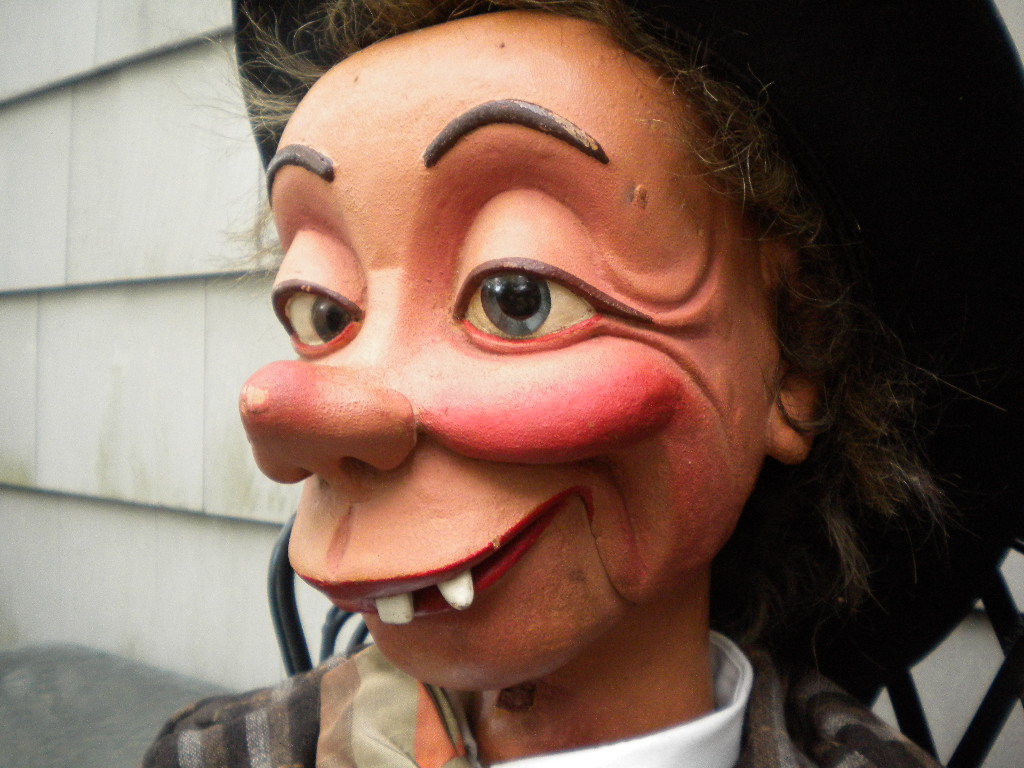
He performed himself, working a figure he called Slick, built in the shape of Mortimer Snerd but with the details deliberately wrong: the eyes placed opposite of Mortimer's, the buck teeth swapped to the other side, the nose thrown off center on purpose.[5] Copy a famous face closely enough to be a tribute, then reverse every detail that would make it a straight copy of Edgar Bergen's copyrighted partner. That's not a mistake. That's a carver's private joke, cut right into the wood.
Where his hands really lived
By the late 1940s Sieving was building dioramas and models for the Illinois State Museum, including a model of New Salem Village, the reconstructed pioneer settlement where a young Abraham Lincoln once kept store and read law.[1] His dioramas of other Illinois historical scenes went into the Lincoln Home museum in Springfield as well.[1] A carved wood sculpture called Jitterbug Dancers, cut from a single block, two figures locked in an embrace and swinging to a beat, dates to around 1950 and belongs to the Illinois Governor's Mansion's Art of Illinois collection now.[6] He was still working when he died, on diorama displays for the Long Nine Museum in Athens, Illinois, named for the nine unusually tall state legislators, Lincoln among them, who once represented Sangamon County.[1] Ventriloquist, magician, architectural carver, clockmaker, museum diorama artist. Most men pick one trade. Art kept picking up new ones and never fully set any of them down.
The kid on the other end of the line
In the back of a ventriloquism magazine called the Oracle, Sieving ran a listing: his name, his city, a phone number, no address.[7] A seventeen year old ventriloquist named Jay Johnson found it and dialed. An elderly man picked up. "That would be me," he said, and told Johnson he was retired and didn't know how the kid had even gotten his number.[7] He asked around before he agreed to anything: what exactly are you looking for, a doll? Because he wasn't a doll maker.[8] Whatever young Johnson said back must have satisfied him, because by the time Johnson called again, Sieving had already started building.[7]
The figure that came out of that phone call, Johnson named him Squeaky, went on to work the stage with him for years, through the era that put ventriloquism on network television and eventually into the Broadway solo show that won Johnson his Tony.[7] In a 2004 interview, Johnson called Sieving "a sweet, sweet guy," the kind of man who joked that his own act was "very de-sieving."[7] Years afterward, watching Johnson work a nightclub set in Los Angeles, another ventriloquist told him: "I'm certainly glad that there will be somebody to run with the football when the pass is thrown." That ventriloquist was Edgar Bergen. Squeaky was sitting right there for it.[7]
How to spot his work
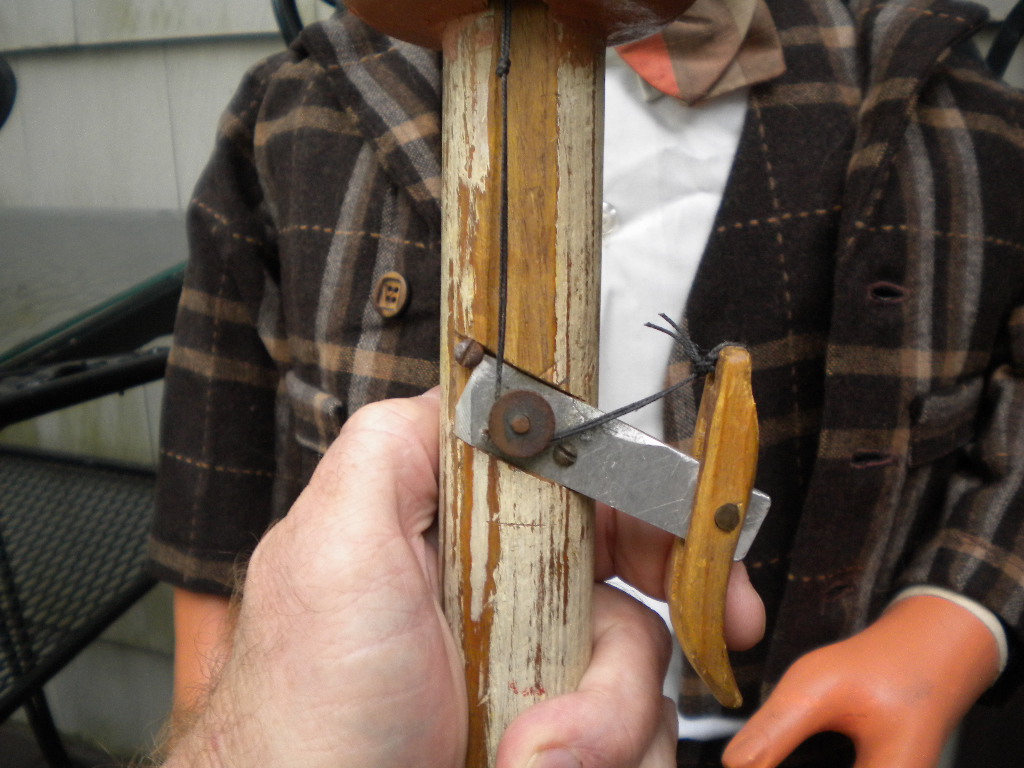
Sieving's other figures show a different side of the same hand. The mechanics inside are steel and brass, run on rigid direct linkage instead of the cord and spring nearly every other American maker of his era used, "as well as most anyone could possibly do," in one auction house's own assessment.[9] That's a level of engineering almost nobody else in the trade bothered with. The only other makers on record building that way came along decades afterward.[9] Slick ran simpler: one function, the mouth, worked by a leather thong that had dried out by the time collector Dan Willinger got hold of the figure, and it snapped the first time anyone pulled the lever. A restorer named Lee Dunn restrung it, and it works fine now.[5][10] Whatever Sieving engineered for paying customers, he apparently built tougher than what he kept for his own act.
He built for at least one working performer outside his own circle, too: The Great Gangrene, made for Phil D'Rey, the New Orleans ventriloquist who served for years as the poet laureate of the Oracle, the International Brotherhood of Ventriloquists' own magazine, and who sold his monkey and trumpet acts to vents as far off as Australia and Arabia.[11]

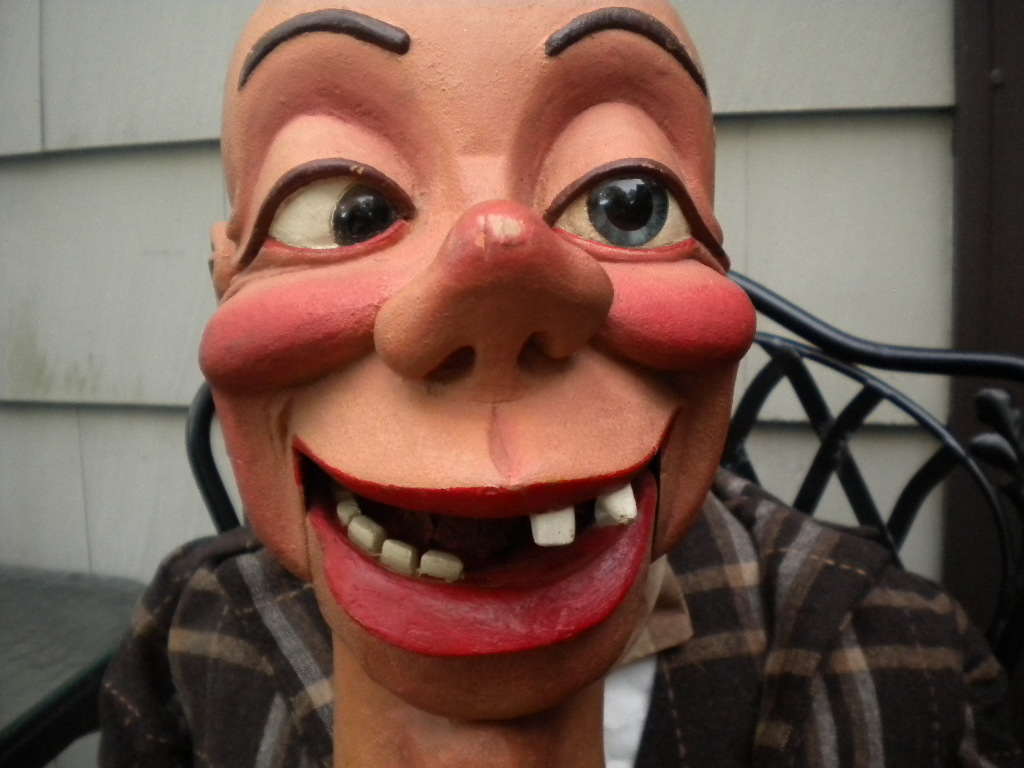
Slick
Sieving's own performing figure. Look closely and the homage to Mortimer Snerd runs backward: the eyes on the wrong side, the buck teeth on the wrong side, the nose pulled off center on purpose.

Slick, in costume
The same figure, dressed for the act: plaid suit, bow tie, a hat too big for the head under it. This is what Sieving worked with when he performed his own material.

Another Sieving, 1940s
A separate Sieving figure in the same Mortimer-style mold, carved basswood, offered at a 2016 auction. Two examples, two different sales, one obscure hand behind both.
What the market missed
When a piece of his work crossed the block in the 2015 dispersal of the Willinger collection, the catalog called him "one of the more obscure but great makers": carved cheek pouches unlike anything else in the sale, a groove running clean through the muzzle and down the chin, two stark white buck teeth standing alone at the corners of the mouth, no maker's mark anywhere inside the head.[12] It went unsold against an estimate of two thousand to twenty five hundred dollars, the highest estimate in the whole session, and nobody bid.[12] A basswood Sieving in the Mortimer style turned up again at a different auction the following year.[13] Auction houses call his work great in one sentence and can't move it in the next. That gap between what people say a craftsman is worth and what they'll actually pay him is about as old as the trade itself.
The last diorama
Art Sieving married Edna Mae in 1925. She died in October 1970, four years ahead of him.[1] He died in Springfield on February 9, 1974, at seventy one, with a diorama for the Long Nine Museum still unfinished on the bench.[1]

The paper called him "an internationally known magician, sculptor and ventriloquist" the week he died, and even that undersold him a little, the way these notices tend to. A man who kept moving between five different trades his whole life, and left something behind, on public display or on a Broadway stage, in every single one.

Ten figures in a lifetime, and Sieving still found time to mismatch Slick's eyes and teeth on purpose. That's not sloppy work, that's a lawyer-proof wink carved straight into the grain.— Freddy Fiddlesticks, spokesdummy
The figures
7 photographs across 1 cataloged object. Each object is one entry in the register — where a character name covers two physical figures, they stay two entries, because the character outlives the object more often than the record admits.
Mortimer Style 7 photographs
- Size
- 40"
- Materials
- leather
Recorded owner Ventriloquist Central Collection as stated on the source page when it was written — not current ownership
Sources
- Find A Grave, memorial 194320746, Arthur George Sieving — reproducing the Daily Illinois State Journal obituary, February 10, 1974
- Willinger Collection auction catalog (AuctionZip, 2015), Session 1, Lot 49
- Illinois Governor's Mansion, "Art of Illinois" exhibition — Art Sieving biographical note
- Willinger Collection auction catalog (AuctionZip, 2015), Session 1, Lot 49
- Dan Willinger, "This Is Slick, an Art Sieving Masterpiece," Ventriloquist Central Blog
- Illinois Governor's Mansion, "Art of Illinois" exhibition — Jitterbug Dancers, c. 1950
- Jerry Tallmer, "A Ventriloquist and Then Some at the Atlantic," amNewYork, May 11, 2004
- David Malmberg, "A Conversation with Jay Johnson, Pt. I," Vent-O-Gram
- Dan Willinger, "Art Sieving Mortimer Style Figure," Ventriloquist Central
- "Ventriloquist Central Collection Video Series – Art Sieving Mortimer Style Part 2," Ventriloquist Central Blog
- David Malmberg, "A Conversation with Jay Johnson, Pt. I," Vent-O-Gram — on The Great Gangrene and Phil D'Rey
- Willinger Collection auction catalog (AuctionZip, 2015), Session 1, Lot 49 — condition, estimate and unsold result
- "Art Sieving Ventriloquist Figure ca. 1940's Carved Basswood," 2016 Crown Auction, Lot 34, via WorthPoint