
Figure maker
Howie Olson
Howard Olson · died 1992
A Madison television host who made figures and taught building on the side, and the son of a performer called The Great Chesterfield.

Some performers spend years hunting for their gimmick. Howie Olson was handed his before he could walk. In 1911, when he was a year old, his father bought him a red-wigged figure named Reddy from a furniture and wood-carving shop in Chicago, for eleven dollars.[1] By age two, Howie was carrying on conversations with a teddy bear. Not long after, Reddy replaced the bear, and the boy was singing Swanee River with no lip movement at all.[1] Three generations of his family did this exact same impossible thing, grandfather to father to son, and Howie is the one who lived long enough to teach the next batch of kids how it's done.[2] So pull up a chair. Let me tell you about Howie.
Little LeRoy, the Boy Wonder
He wasn't born Howie. He was born Howard Minor Olson, on August 12, 1910, the son of a Chicago vaudeville ventriloquist who worked under the name The Great Chesterfield.[3] Dad decided the two of them could work as a double, and billed the boy as Little LeRoy, the Boy Wonder.[1] His real start, in his own telling, came in the second grade, when he was invited to appear alone on his school's assembly program.[1] By his teens he was working Chicago under his own stage name, Chester LeRoy, a name he kept for the rest of his career until 1957.[2] If you ever run across a newspaper clipping or an old program crediting "Chester LeRoy," you were reading about Howie. He toured at nineteen, and in 1939 Chester LeRoy made it to Broadway.[2]
War, Texas, and the teaching bug
He was teaching before he ever built a single figure. At some point in his career Howie traded ventriloquism lessons to a fellow performer named Tommy Windsor, straight up, in exchange for magic lessons.[4] In 1935, a young puppeteer named Bill Baird joined Howie's revue, "Sirens in Satin," and the two men became friends. Baird went on to become one of the giants of American puppetry.[4] Then came the war. The Army Air Corps drafted Howie, and for three years he entertained GIs with a figure he renamed Corporal Eddie for the uniform.[4]
After the war he settled in Houston, ran a local television show in the early 1950s, and kept teaching. A nine-year-old named Dennis Chapman studied under him there, and Howie was the one who got the boy enrolled in the International Brotherhood of Ventriloquists.[5] Decades later, in 2012, Chapman wrote in to say so, adding that he'd lost the figure to one of the many hurricanes that hit Texas and was thinking, at 67, about starting again.[5] By 1956 the Houston act was working well enough that Frank Marshall's Chicago shop listed "Chester LeRoy, the Great Chesterfield's son, of Houston" among its named clients.[6]
Eleven years of live television in Wisconsin
In 1957, Howie settled for good in Madison, Wisconsin, and the name history kept was Howie Olson.[2] He got his own local television show, taught ventriloquism, made figures, and became a regular fixture at Abbott's Vent-O-Rama in Colon, Michigan, the annual gathering ground for the whole magic and ventriloquism trade.[2] During the late 1970s and into the early 1980s he was making ventriloquist figures and running his own ventriloquism workshops.[8] The show was called Circus 3, on WISC-TV, and it ran daily for eleven straight years, from 1961 to 1972.[3] Eleven years of live children's television in one market is the kind of career this trade keeps turning up underneath its famous names: not a headline, just a man on the air every weekday for over a decade, raising a whole run of Wisconsin kids on Cowboy Eddie.[7]
Cowboy Eddie was Reddy, renamed. The same eleven-dollar figure his father bought in a Chicago wood shop in 1911, wearing a different hat and a new name, carried Howie through fifty years of stages, television cameras, and a war.[1][7]
The teacher's book
Howie wrote his own textbook. Everything That's Ventriloquism was a twelve-lesson course, written up from the technique of the vent voice through to booking the act, and it was the actual manuscript he used with his own students.[2] Two of his rules hold up as craft, not nostalgia. Look intently at your figure while it's talking, so the audience watches the figure and not you. Look at the audience when you talk, and exaggerate your own mouth movement for contrast.[9] And never move the figure without a reason: repeat a movement too often and it turns boring and distracting. The way to learn real movement, Howie wrote, is to watch children between eight and twelve years old talk to each other, because that's the age most figures are built to play.[9]
He wrote out the whole classic act, too: the Bottle of Beer bit, "Peter Piper Picked a Peck of Pickled Peppers," a full 360-degree head turn for the laugh, a baby cry, a telephone bit done "a la the Great Lester," and a closer built on rapid-fire voice changes.[10] A top-end figure of his own description could do eleven separate things: winkers, blinkers, raised eyebrows, rolling eyes, wiggling ears, an upper-jaw sneer, a fright wig, a light-up nose, a handshake, a nudger, and a moving mouth on a turning head.[10]
That's the working pro talking, in a piece Howie wrote for Newsy Vents in 1979.[10] But in that same magazine he also published the other side of it: a parable about an eighteen-year-old who's spent ten years mastering every classic bit, and sulks backstage at a convention while an old-timer gets a standing ovation doing half the material with a stocking over his hand. The kid finally knocks on the old man's door to ask him to prove it. The old-timer obliges, then lands the real lesson.[10] Howie published that story himself, at 69. Some lessons don't age out of a trade.
Building for other people's shows
By the early 1970s Howie was also building figures for other performers, working through Maher Studios in Colon, Michigan, at the invitation of his friend Clinton Detweiler.[5] Decades later, Detweiler had one of Howie's custom builds on hand: a figure Howie intended as a tribute to Fred Maher's famous Skinny Dugan, the character originally carved by the McElroy brothers. Howie never offered it for sale under that name. He didn't consider the likeness true enough to claim it.[5] That's an integrity call from a man selling figures for a living, and it says plenty about how seriously he took the work of other makers.
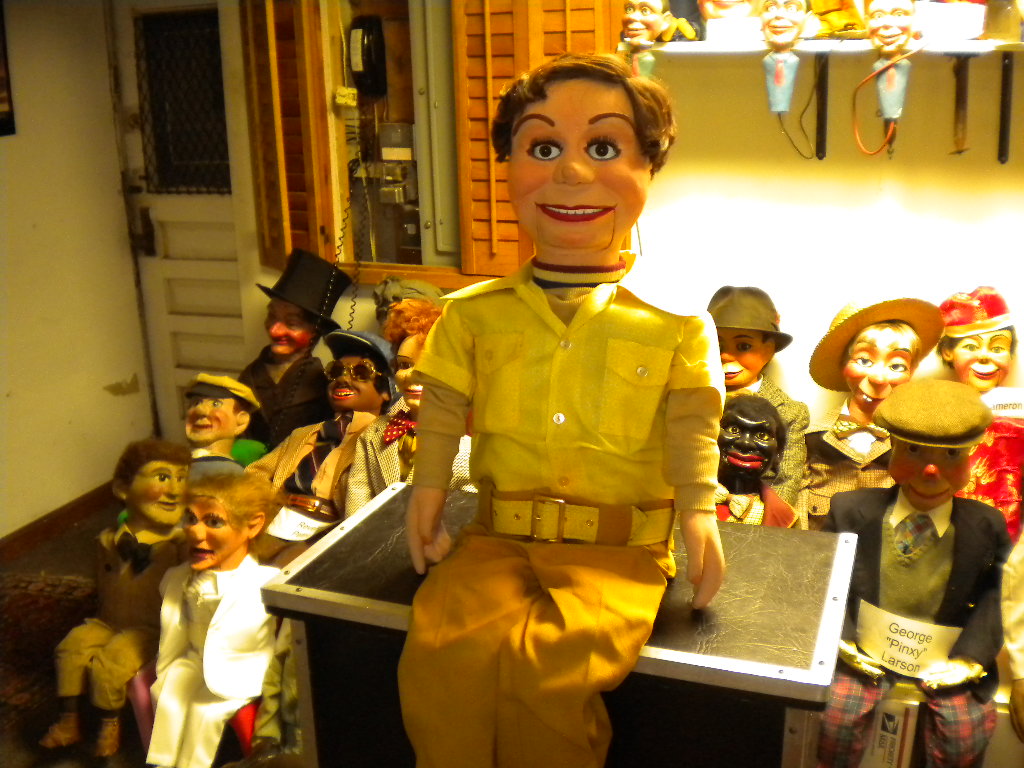
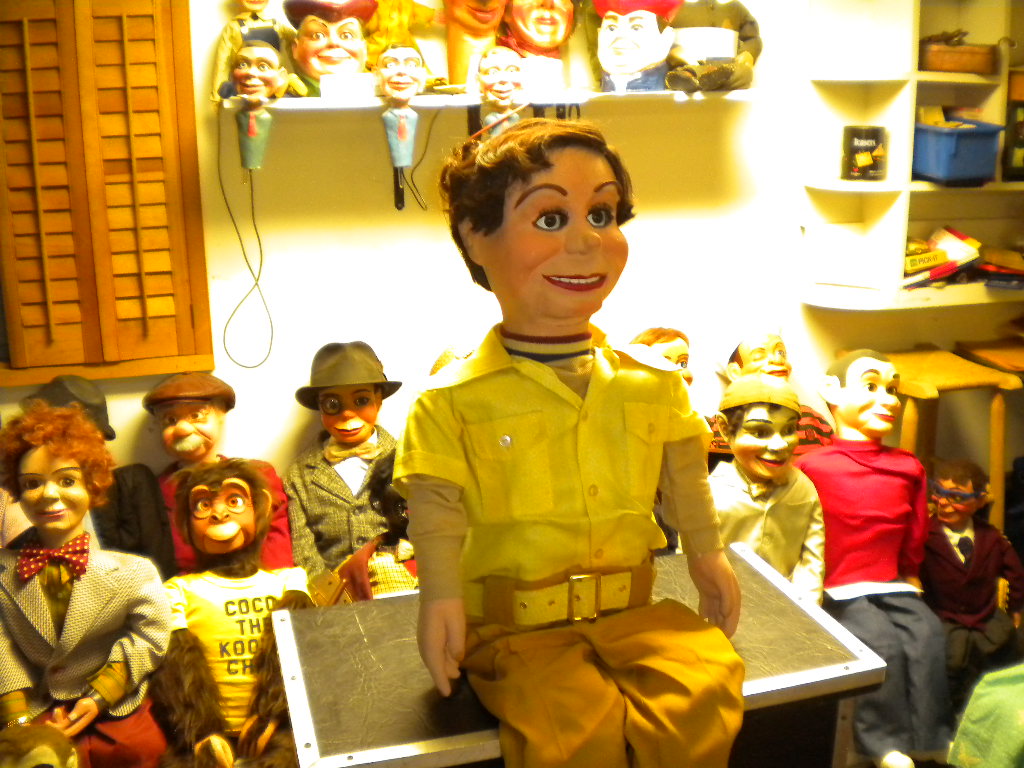
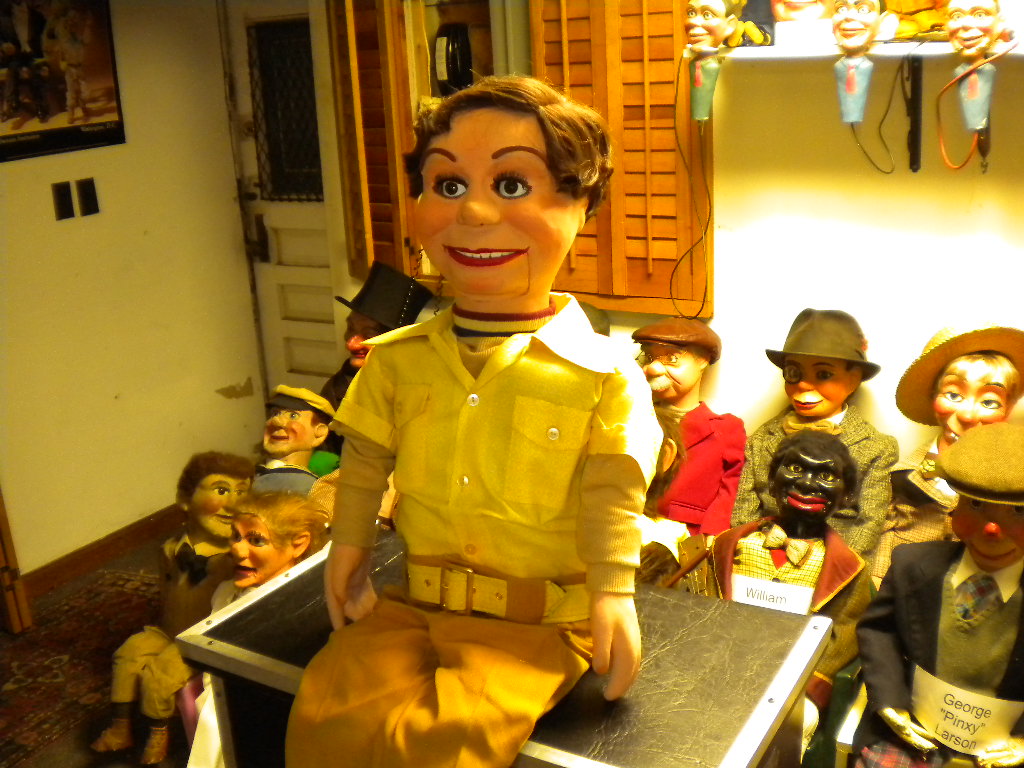
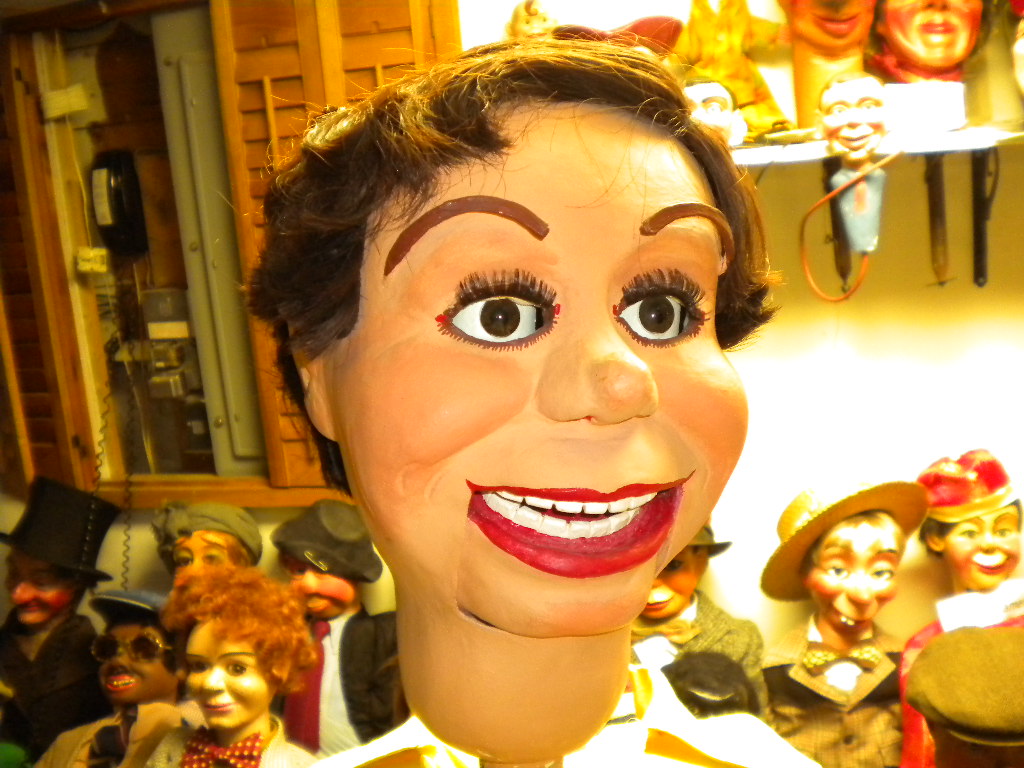
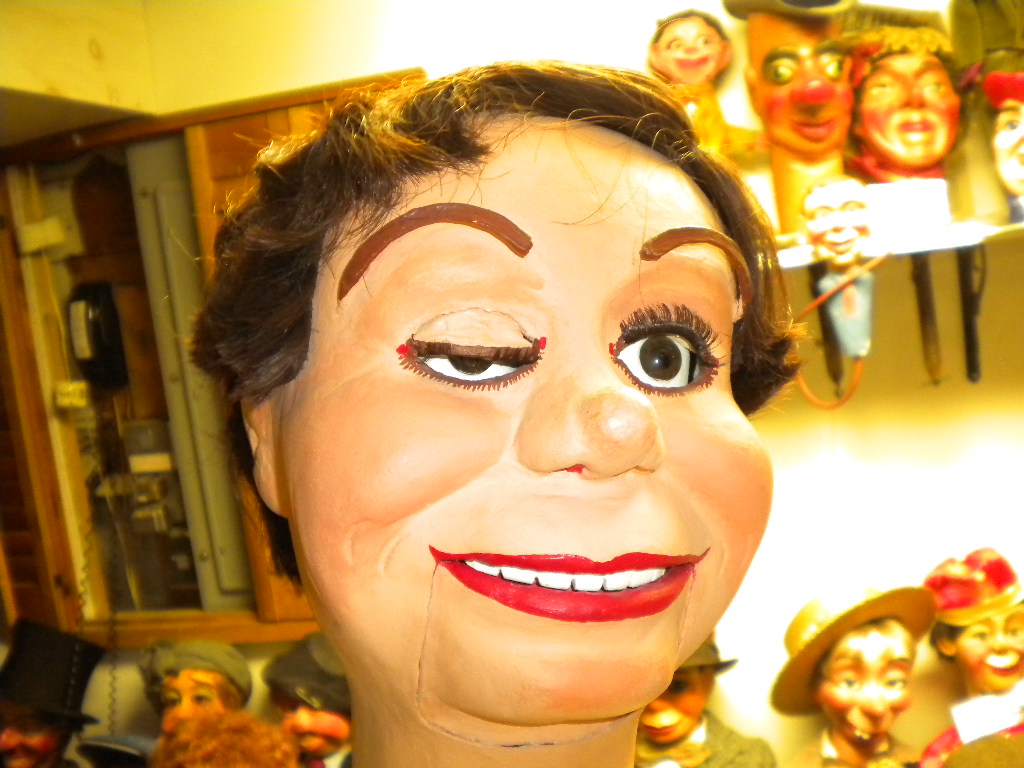
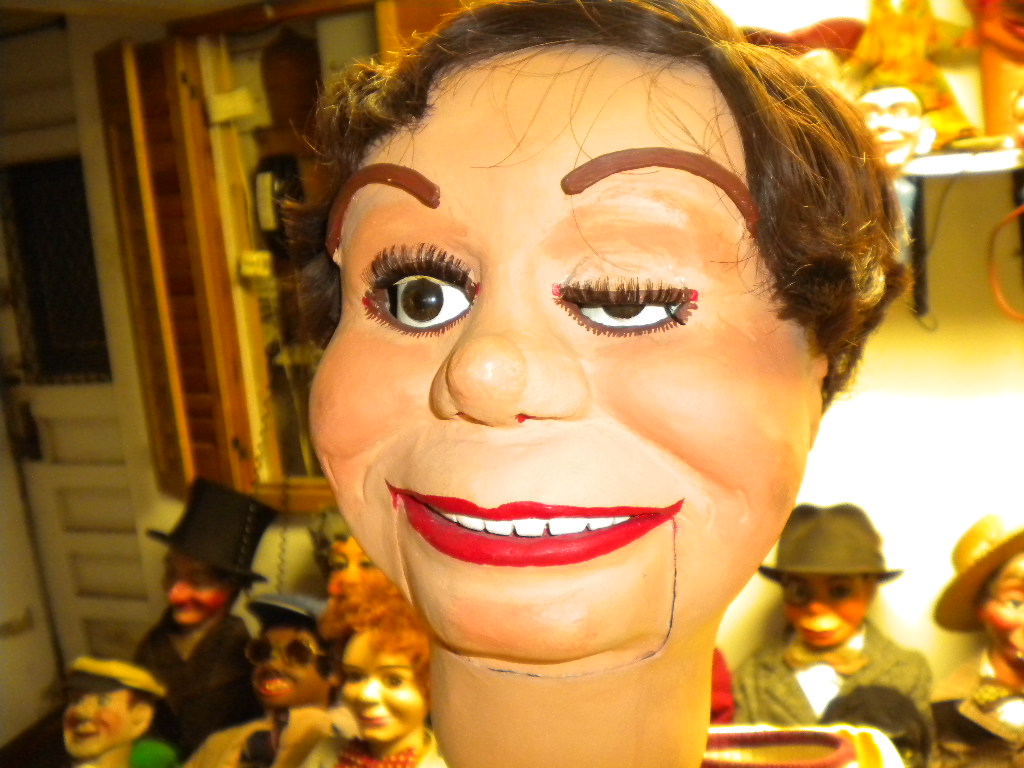
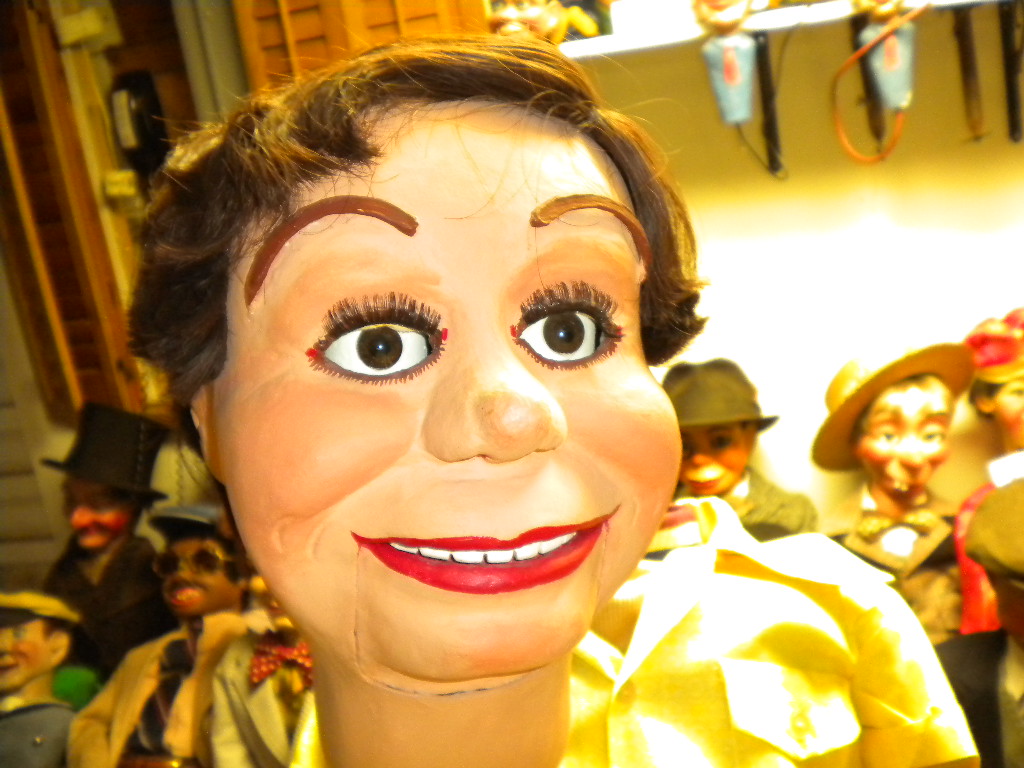
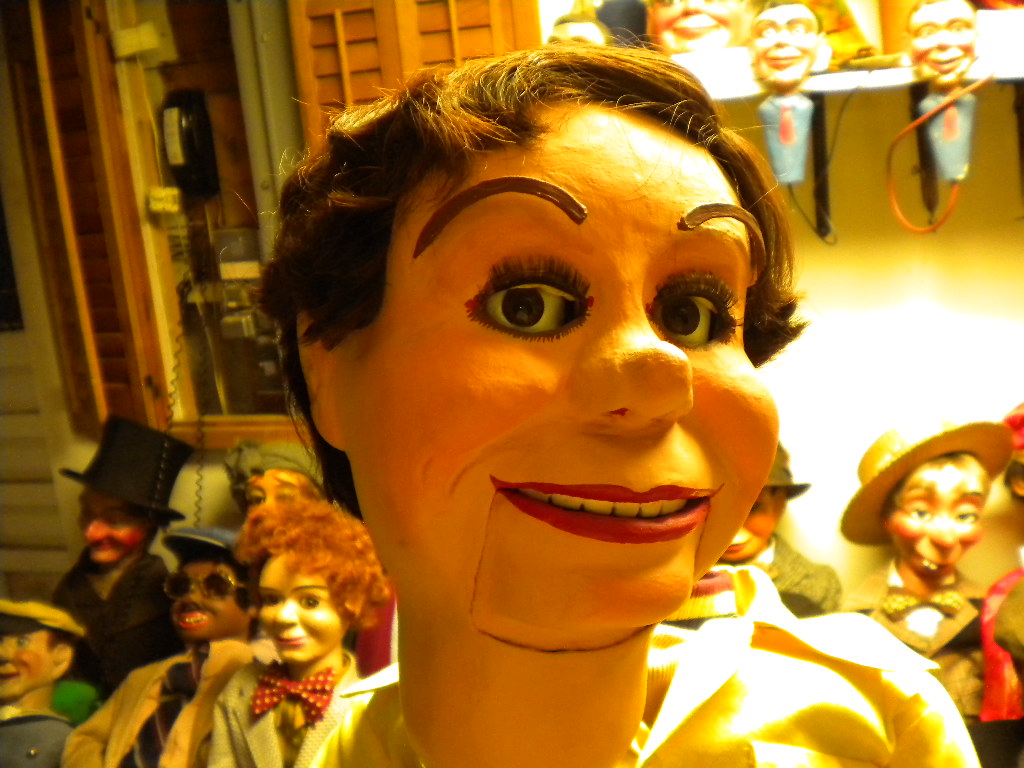
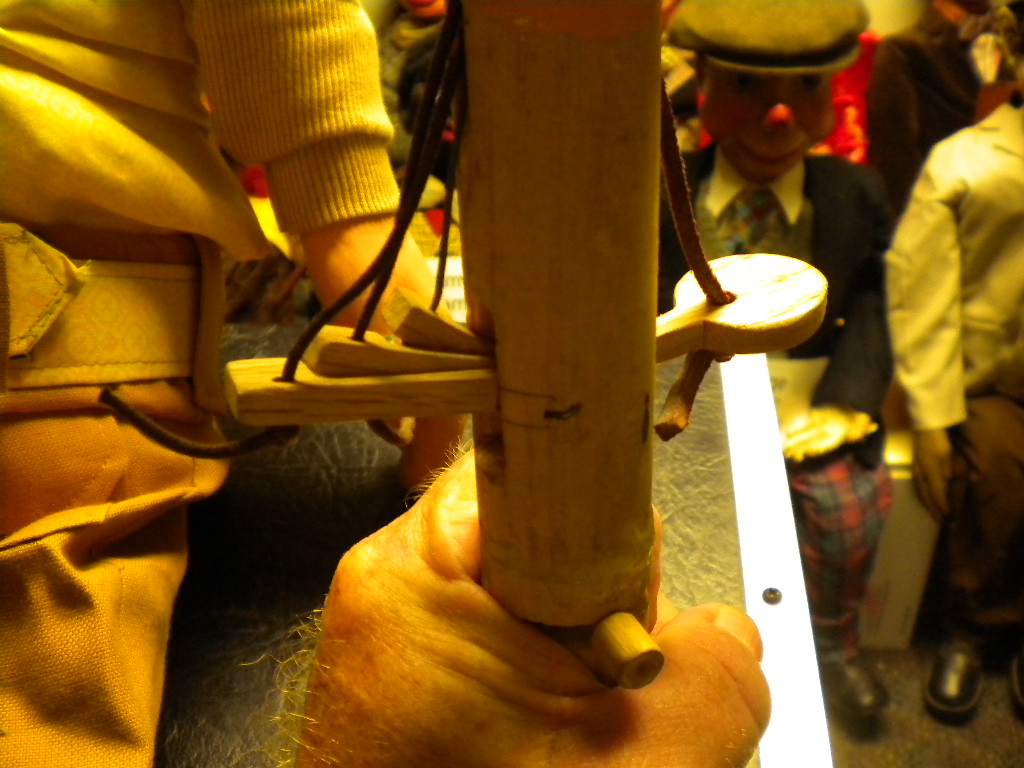
Detweiler later placed his own Howie Olson Skinny Dugan tribute in the Ventriloquist Central Collection rather than sell it. He described the head as cast in a material Howie favored, with self-centering side-to-side eyes, eyebrows raised the Marshall way rather than the windshield-wiper sweep some other makers used, winkers, blinkers, a slot jaw, and wood levers cut in a paddle style, the figure dressed in its original 1970s clothing.[11] It's on the cruder side of the trade, in Detweiler's own words, but the likeness surprised him.[11] A different Show-Biz figure Howie built in 1971 turned up decades later at auction: a boy or young woman in a bobbed pageboy wig and a green-white-and-orange striped shirt, with the maker's name written inside the head.[12]

Skinny Dugan (tribute)
Built for Clinton Detweiler in the early 1970s as a nod to Fred Maher's famous original. Howie never sold it under that name. He thought the likeness fell short of the real thing.

A Howie Olson girl figure
One of his catalog-style figures, later crossing the auction block far from Wisconsin. The face and paint are unmistakably his hand.

A Howie Olson boy figure
Plain plaid shirt, plain jeans, the kind of everyday-kid figure that could carry a school-assembly act or a television segment without a single flourish.
The last years, and Cowboy Eddie's second life
In 1989, Howie found a new musical partner. He and fellow vent Jacki Manna teamed up, and the two performed together into his final years.[2] In May 1991, at eighty years old, Howie moved to Orlando, Florida, and kept right on building figures, this time for Show-Biz Services.[4][2] He died on June 26, 1992.[3] The following month, July 1992, the Vent Haven Museum voted him into its Hall of Fame.[2]
Cowboy Eddie outlived him. Jacki Manna took the figure on: the same eleven-dollar buy from a Chicago wood shop in 1911, eighty years and a whole lifetime later, working for a second performer outside the family.[1][7] A wartime photograph of a young Howie with that same figure, at the time named Corporal Eddie, surfaced on a collectors' blog in 2010. Two people independently confirmed who it was, and one of them pointed to a second print of the same photo living on Jacki Manna's own website.[13]
A little family color survives, too. A photograph from the mid-1930s shows a young Howie beside a woman his biographer guessed, carefully, might be his first wife, Leona.[14] Decades later it was Howie's niece, Karin Olson, who sent the print in, thanking the blog for wanting to remember her "Uncle Howie."[14]

The circle
No performer works alone, and no maker builds in a vacuum. Here's Howie's world: family, students, friends, and the museum that remembered him.
Cowboy Eddie is the reason plenty of people outside this trade have heard Howie Olson's name at all, and Howie would likely have been fine with that. A partner that outlasts you and keeps working in someone else's hands. That's not losing your legacy. That's proof the thing worked in the first place.

Eleven bucks for Reddy in 1911, and the kid still owed the wood shop change for eighty more years of showing up. Not a bad exchange rate for a family trade.— Freddy Fiddlesticks, spokesdummy
The figures
9 photographs across 1 cataloged object. Each object is one entry in the register — where a character name covers two physical figures, they stay two entries, because the character outlives the object more often than the record admits.
Skinny Dugan 9 photographs
- Movements
- slot jaw / moving mouth; self-centering eyes; winkers; raising eyebrows
- Dates given
- 1970
Recorded owner Ventriloquist Central Collection as stated on the source page when it was written — not current ownership
Sources
- Howie Olson, autobiographical excerpt from The New Vent-O-Gram (1971), reposted at Newsy Vents blog, November 2005
- Clinton Detweiler, "'Howie' Olson Course," Mr. D's Ventriloquist Blog, November 2011
- Find a Grave, memorial 86628445, Howard Minor Olson
- Magicpedia, "Howard Olson," Genii Magazine wiki
- Clinton Detweiler, "Howie Olson Figure," Mr. D's Ventriloquist Blog, July 2012
- IBV Directory of Ventriloquists, The Oracle, March 4, 1956 issue
- Ventriloquist Central, "Ventriloquists of the 20th Century"
- Ventriloquist Central, "Ventriloquist Figure-Makers"
- Clinton Detweiler, "Manipulation of the Figure," Mr. D's Ventriloquist Blog, May 2010, quoting Howard M. "Howie" Olson, Everything That's Ventriloquism
- Clinton Detweiler, "Demontrator," Mr. D's Ventriloquist Blog, July 2012, reprinting Howie Olson's Newsy Vents columns of 1979
- Ventriloquist Central Collection, Howie Olson's Skinny Dugan tribute
- eBay listing, "Incredible Howie Olson Ventriloquist Dummy made for Show Biz in 1971" — screenshot, Jimmy Vee collection
- Clinton Detweiler, "Mystery Ventriloquist," Ventriloquist Central Blog, December 2010
- Clinton Detweiler, "Turning Back the Clock," Mr. D's Ventriloquist Blog, February 2011