
Figure maker
Madeleine Maher
The builder behind the earliest Maher Studios figures, and one of very few women documented as a maker in this field.

Every family carries one relative whose name never made it onto anything official. In ours, that's Madeleine Maher. Fred's name is on the course, the catalog, the letterhead, the company history that survives him. Madeleine's name, when it survives at all, is written in pencil on the underside of a wig, where only a repairman lifting the hair fifty years later would ever find it. She ran the whole outfit alone for seventeen years. She built figures the entire time, with her own hands, at her own bench. For most of this trade's history she has been a footnote to her own husband. Not today. Pull up a chair. Let me tell you about Madeleine.
A sideline on Casgrain Street
She was born Madeleine Tatham, daughter of Charles H. Tatham, director of the YMCA Boys' Radio Band in Detroit, a member of the Ionic Lodge of the Freemasons, the Detroit Consistory, the Moslem Temple, and a founding member of Kiwanis Club No. 1.[2] Lodges and service clubs were exactly the circuit her husband Fred Maher spent his career working. She married into this family's trade before there was a trade to marry into.
In 1934, to supplement Fred's income, Fred and Madeleine opened Maher Ventriloquist Studios at 1700-J Casgrain, Detroit, Michigan.[1] Their flagship product was the Maher Course of Ventriloquism, sold through small classified ads tucked into Boys' Life and Popular Mechanics. When somebody bought the course, Fred kept the relationship going by offering them a figure, and Fred and Madeleine built those figures themselves, out of hand-poured molds and plastic wood.[1] Madeleine had trained for exactly this kind of work. Years before any of it started, she majored in art at the J.P. Ricker Art School in Detroit.[3] She was the association's first artist, too: the earliest NAAV logo, used on Maher material for years, was her own drawing, before Dave Miller's design replaced it in the mid-1970s.[21] And whatever Bill Maher fans might guess, the family always said their own name "May-Hair."[20]
Seventeen years alone
Fred Maher died on February 25, 1952. He was taken ill while entertaining a group of Masons in Findlay, Ohio, and was gone three days later, at fifty-five.[1] Madeleine did not sell the business. She ran it, alone, for the next seventeen years, and Clinton Detweiler, the man who eventually bought it from her, never once called her a caretaker widow. His own phrase for the period was that Maher Studios was "owned and operated by Madeleine Maher."[6]
Her manufacturing history, told in three stages, is the clearest record we have of what a widow running a national supply business actually did with her days. Stage one, while Fred was alive: they imported complete Insull figures from Davenports of London, head and body both, and sold them whole. Stage two, to save on shipping: they imported just the heads, and Madeleine built the bodies herself in Detroit. Stage three belongs to her alone. When the English supply of Insull heads dried up, she built her own plaster molds and began casting heads out of plastic wood, because Fred was gone and there was nobody left to place the overseas order.[5]
She told a reporter from the Grosse Pointe News, three years into widowhood, exactly how she saw herself. "I am not a ventriloquist," she said, "but I love to make my wooden children." Those wooden children, she said, had gone out to people in Africa, Alaska, Germany, and France.[3] A one-woman Detroit workshop, shipping the world, run by a woman who could not do the very thing her figures were built for.
The maker's hands
Here is where the record finally gets specific, because collectors have spent decades learning to spot her work.
She did not invent conversion figures out of nowhere. She is the first person in this whole trade documented taking a mass-market toy, the cheap "Dummy Dan" dolls sold for the children's market, and rebuilding it into a professional figure.[7] She re-sculpted the nose, cheeks, and lips in plastic wood, added real moving eyes and a working jaw, and sold the result under her own catalog names: Hal, Tiny, Russell, Dale.[7][8] When anyone argues a conversion isn't a "real" figure, they have to explain that one of the most important supply houses American ventriloquism ever had started exactly that way.
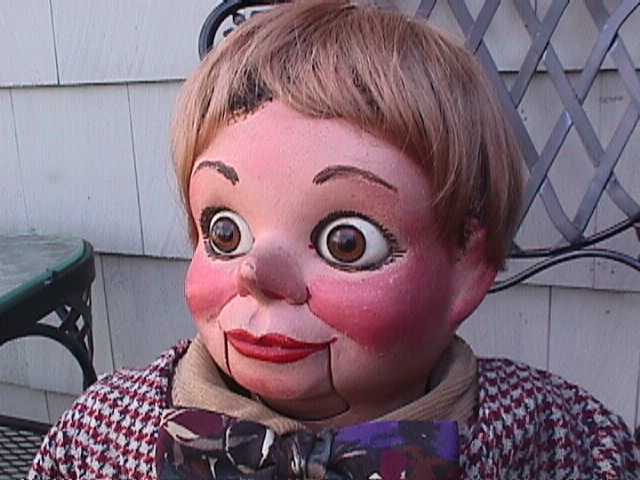
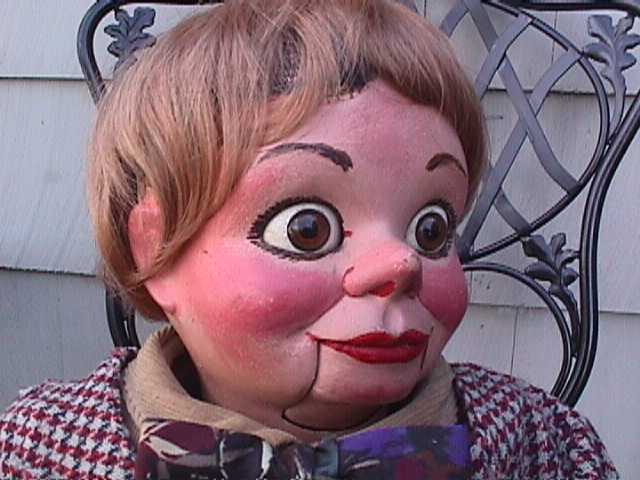
Her figures carry marks nobody was supposed to find. She had her wigmaker, Meyer Jacoby of New York, write the customer's surname on the underside of every wig, and she wrote the figure's own name on the crown of the head, under the hair, in her own hand.[12] She gave her figures big eyes with a black marble set into a wooden bead for the pupil, a look Detweiler liked so much he brought it back decades later for his own retro line.[11] And she solved a problem almost nobody else in the trade solved: a figure that sits without tipping. She built the front edge of the leg board out beyond the front of the body, adding just enough length that the figure could not fall forward. Dan Willinger, who has handled more of these figures than nearly anyone alive, put it plainly: "I have not seen any other maker do this kind of bottom."[13]


Inside her own Detroit shop, the work was divided the way a real production line divides it, not a hobby. George Eazer, her mechanic, built and fit the moving parts. Madeleine painted every head and set every wig herself.[14] She taught her methods hands-on to whoever came through next, including the man who eventually bought the whole business. Clinton Detweiler learned to build a body "in much the same manner as I was taught by Madeleine herself," down to a trick nobody would think to write down: cutting a figure's upper teeth from the white plastic label liner of a cottage cheese container, because in those years the label peeled off clean.[15][16]
The faces you don't know you've seen
Madeleine Maher built Willie Tyler's Lester. Both of him, actually. She made a second Lester as an emergency backup, with George Eazer fitting the mechanics on each one, years before the Detweilers ever bought the business.[17] Willie Tyler, asked years later who made his figure, didn't hesitate: "Madeleine Maher made him. In fact, all the Lesters were made by Madeleine."[18] Willie Tyler is still touring today, and he still remembers visiting her at her home in Detroit.[6]
In April of 1956, she built a caricature puppet of Steve Allen, host of The Tonight Show, and mailed it to him cold. It went on the air on April 25, 1956. The show's producer was impressed enough to invite Madeleine Maher onto the program herself. She never went.[3] That is the whole woman in one story: good enough to land a coast-to-coast television spot on the strength of a puppet mailed through the post, and quiet enough to send someone else in her place. The someone else was Ted Lloyd, known on Detroit television as "Sagebrush Shorty," and what he carried onto the show that week was Skinny Dugan, the McElroy figure Fred had performed with for years. Madeleine sold it to him after Fred died, on one condition: the figure's name could never be changed.[3][1]
By the time Detweiler examined her work decades later, he could recognize a Maher head on sight, from across a repair bench, without opening it. He was honest about the limits of that skill, too. Asked once whether a photographed figure was hers or his own later repair, his answer split the object in two: "The sculpting appears to be Madeleine's," he wrote. "But the smoother finish and the paint job look more like mine."[19] That is as close to a compliment as one careful craftsman pays another. He could not always tell his own hand from hers.

Tiny, decades later
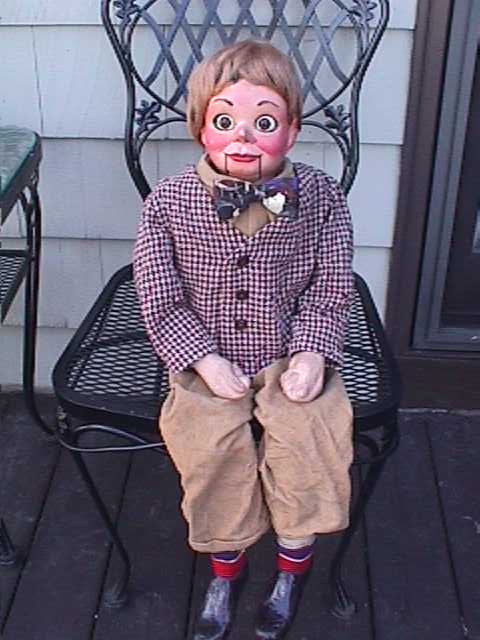
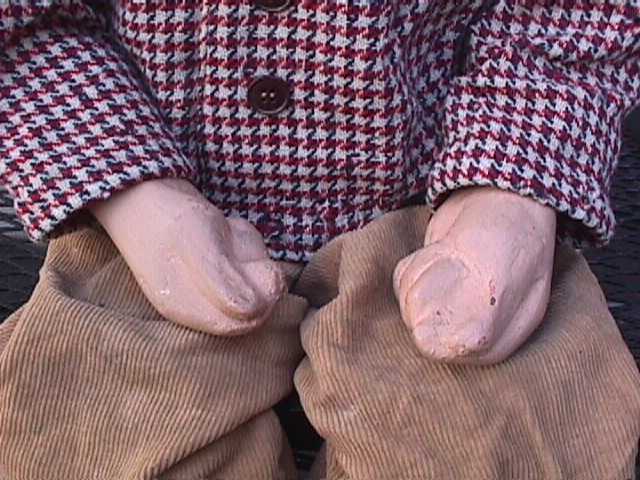
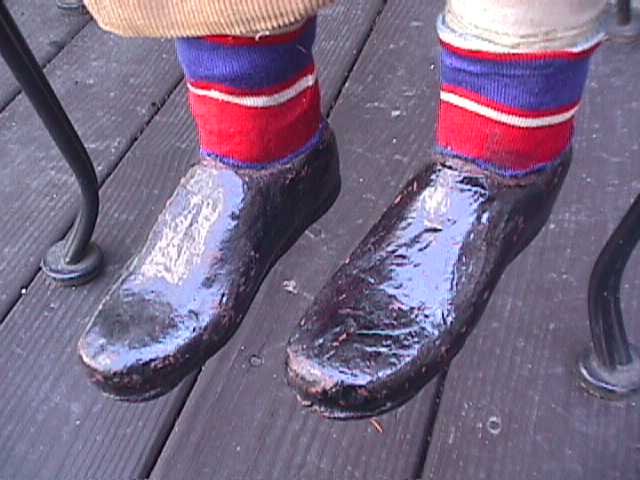
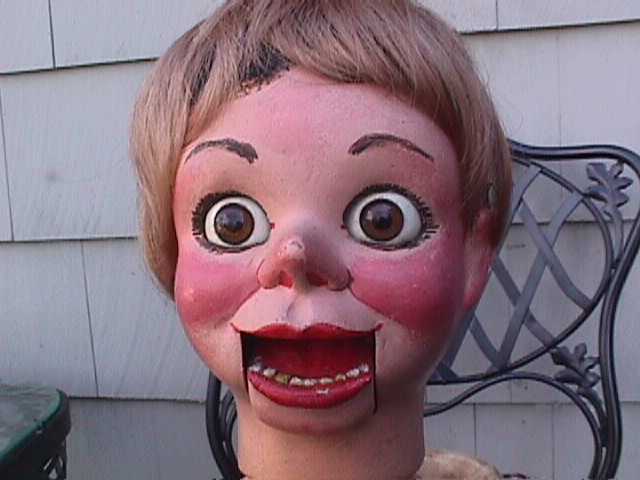
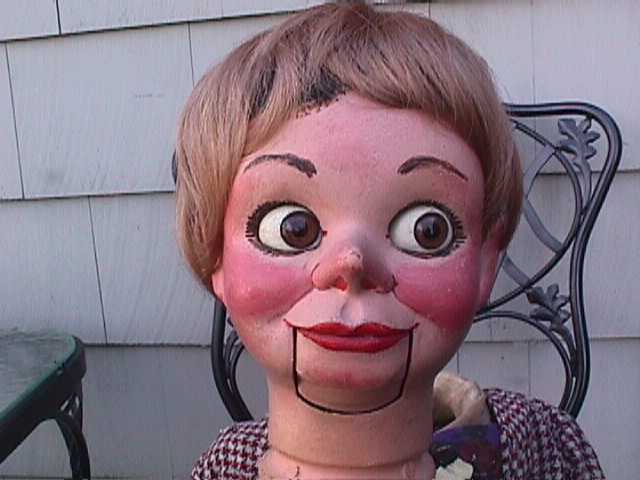
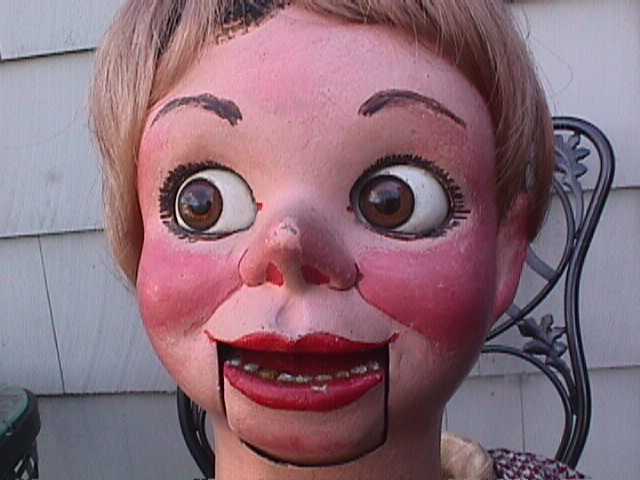
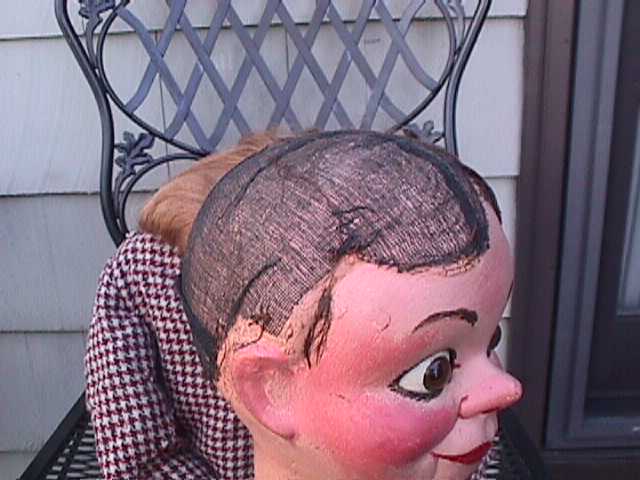
The same figure, resurfacing at a later sale, in the same houndstooth jacket she dressed him in. Two independent photographers, two different decades, the same maker's hands.

The wig lace
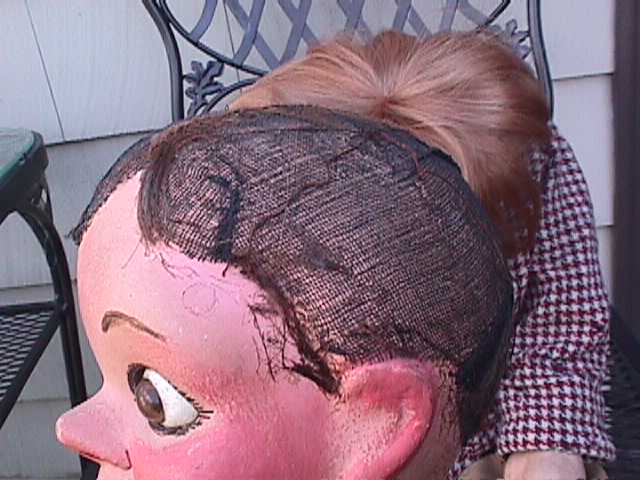
Under the hair, the original lace and the hairline she drew on the bare head before she ever laid it down. A wigmaker's procedure, preserved only because the hair itself is long gone.

The anti-tip base
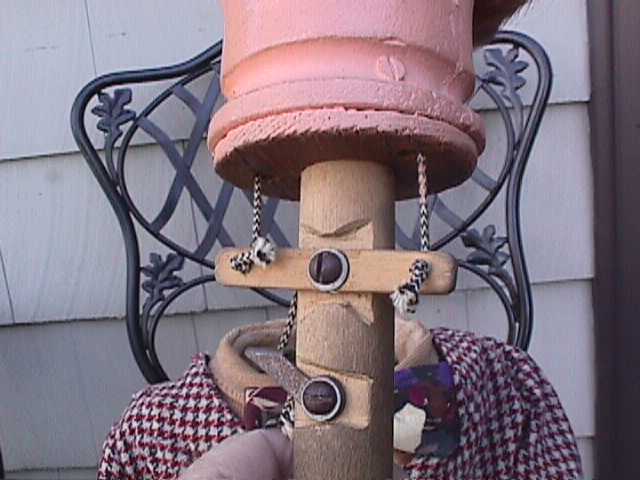
Turned upside down: the extended board that keeps a Maher figure from tipping forward, a design Dan Willinger says he has never seen from any other maker.
The circle
The handover, and the last figure on the bench
In August of 1969, Madeleine sold Maher Studios to Clinton and Adelia Detweiler. She shipped them more than sixty boxes of the business's material, and the Detweilers, in the middle of their own fourth child being born that same hot summer, did not even open all of them at first.[20] Before she let go of the bench for good, she taught Clinton how to work it. And that same year, with George Eazer at her side one last time, she built one more figure. It was her last. She built it for Clinton's own use, and he performed with it for about ten years before he retired it.[4]
Clinton and Adelia eventually gave both bookends of the Maher story to Vent Haven Museum: the very first professional figure Fred and Madeleine ever built together, back in the 1920s, and Madeleine's own last figure, from 1969. Both are on permanent display in Fort Mitchell, Kentucky, alongside more than five hundred of their peers.[4] Her work still turns up in the hands of working performers, too. Todd Oliver, who built a national career on his talking dogs, keeps a rare, authentic Madeleine Maher figure in his own collection, one that Clinton Detweiler helped him find years after Madeleine was gone.[24]
She died on April 19, 1975, six years after selling the business, at an age and in a place the record still doesn't give us.[3] Search for her today and you will not find a marked grave. A woman who ran one of this trade's most important schools for seventeen years, alone, does not have so much as a headstone anyone has located.[3] We can't fix that from here. But we can stop leaving her out of the story.

Seventeen years running the whole outfit and the only signature she left the world was pencil under a wig, where a repairman had to go looking for it. I'd say that's a shame, but honestly, a dummy knows exactly how that feels.— Freddy Fiddlesticks, spokesdummy
The figures
11 photographs across 1 cataloged object. Each object is one entry in the register — where a character name covers two physical figures, they stay two entries, because the character outlives the object more often than the record admits.
Tiny 11 photographs
- Materials
- papier-mâché; carved wood
- Movements
- slot jaw / moving mouth; self-centering eyes
Recorded owner Ventriloquist Central Collection; another collector. as stated on the source page when it was written — not current ownership
Sources
- International Ventriloquist Society, "Ventriloquist Fred Maher"
- "Charles H. Tatham — Y.M.C.A. Band Director Dies in Hospital," Detroit Evening Times, Jan 27, 1942 — Library of Congress, Chronicling America
- Victor Edward Swanson, Here, I Tie A Bunch of Dummies Together, The Hologlobe Press, Version Three, 25 May 2019
- Newsy Vents No. 51 — scanned document, Jimmy Vee collection
- Clinton Detweiler, Mr. D's blog — the three-stage Maher/Insull manufacturing history
- Clinton Detweiler, quoted, International Ventriloquist Society profile — "owned and operated by Madeleine Maher" and Willie Tyler's remembered visit
- Ventriloquist Central Blog — Madeleine Maher as the first toy-figure converter
- Ventriloquist Central Blog, "Tiny, A Rare Early Maher Ventriloquist Figure"
- Clinton Detweiler, Mr. D's blog — the black-marble-in-wooden-bead eyes
- Clinton Detweiler, Mr. D's blog — the wig lace and the customer's name underneath
- Ventriloquist Central Blog, "A Seat Method for Ventriloquist Figure"
- Clinton Detweiler, Mr. D's blog — the Detroit shop's division of labor
- Clinton Detweiler, Mr. D's blog, "Introducing..." — taught the bench by Madeleine herself
- Clinton Detweiler, Mr. D's blog — the cottage-cheese-container teeth
- Clinton Detweiler, Mr. D's blog, "Lester's Roots"
- Willie Tyler, quoted, Vent-O-Gram
- Clinton Detweiler, Mr. D's blog, "Mystery" — unable to tell his own shop's finish from hers at a distance
- Clinton Detweiler, Mr. D's blog — how the Maher family pronounced their own name
- Clinton Detweiler, Mr. D's blog — the sixty-plus boxes shipped in August 1969
- Clinton Detweiler, Mr. D's blog — Madeleine Maher drew the first NAAV logo
- Rev. Jimmy Davis, Distant Voices, Spring 2010 — scanned document, Jimmy Vee collection