

Pull up a chair, folks, because this story runs backwards before it runs forward. A kid in Chicago did impressions so good that his friends told him he ought to be a ventriloquist. Only problem: he did not know what the word meant. He had to look it up in the dictionary.[1] That is the whole shape of Edgar Bergen's career in one sentence. A gift he could not even name yet, that he spent the next fifty five years teaching an entire country to fall in love with.
The boy who had to look up the word
Bergen was born Edgar John Berggren in Chicago in 1903, the son of Swedish immigrants.[2] When he was five the family moved to Decatur, Michigan, and stayed eleven years. A local doctor named William Bope took an interest in the boy and became something like his first mentor, and Bergen got his start in show business right there at the Decatur Village theater.[3] He bought his first instruction book at eleven for twenty five cents, and a Waterbury newspaper in 1938 remembered it a little differently: mail order lessons, the same correspondence course trade that quietly built half of American ventriloquism.[4][5] Either way, he also worked from Hermann the Great's Wizard's Manual to learn the mechanics.[6] Then he saw the Great Lester perform, and that settled it. Years later Lester's own written testimonial hung on a wall at Vent Haven, naming Bergen among his students and calling Lester, in Bergen's own words, the greatest of all ventriloquists and the greatest of all teachers. The museum puts the lineage plainly: if Bergen is the father of modern ventriloquism, Lester is the grandfather.[7]
He was resourceful before he was famous. When a stranger loitered at his family's front door, it was young Bergen's thrown voice through the other side of it that scared the man off.[8] His first paid date came at a broken down theater on Clark Street in Chicago. He was promised five dollars, and the manager liked the act enough to hand him five dollars and a quarter, a bonus he still remembered by name fifteen years later.[9] He enrolled at Northwestern to satisfy his parents, who wanted a doctor in the family, and helped pay his own way working the lyceum circuit, the same church and hall dates that quietly built half this trade. Pre med lost.
A block of wood on Clark Street
The dummy that made him famous did not come out of an art studio. He commissioned it from a Chicago woodworking shop, Theodore Mack & Son, that mostly built furniture, architectural carvings and signs.[2] In 1922 that shop carved the head that became Charlie McCarthy, modeled on a real Irish newsboy Bergen used to sketch near his high school. Charlie got his first name from the newsboy and his last name from the shop that carved him.[4] Bergen paid thirty six dollars for it, by his own account, and before that he had been getting by with a papier mache dummy he called nothing more than a mask effect. It was no good.[9]
Charlie started out in a newsboy's cap. He graduated to a top hat and monocle at New York's Helen Morgan Club, once the act got too classy for a kid off the street.[4] There is a wonderful story behind that costume. Bergen first wanted to pair Charlie with Esky, the mustached mascot off the cover of Esquire magazine. Esquire liked the idea, but wanted an annual license fee for the use of the character. Bergen decided that was bad business, so he gave Charlie a monocle, a top hat and tails of his own instead, and never paid anybody a dime for the look.[10] Owning your own character outright instead of renting somebody else's fame may be the single best business decision any ventriloquist ever made.
He never trusted the world to just one Charlie. By his own account he kept twenty spare bodies and fifteen suits on hand, though the original head somehow never showed the wear.[9] His workshop eventually filled three buildings, with a private studio just for Charlie, and a whole separate room in the house reserved entirely for Charlie's wardrobe.[11][12] A performer who depends on one irreplaceable object learns to keep a spare. Bergen kept several.
Radio's greatest absurdity
Here is the joke at the center of the whole story. A ventriloquist's entire act depends on being seen. Every other kind of vaudeville performer, a singer, a musician, could move over to radio and lose nothing at all. A ventriloquist could not.[13] By the early 1930s the trade genuinely worried it might not survive the death of vaudeville.
Bergen had already packed Charlie away in a trunk, figuring his last vaudeville date was behind him, when a booking at Chicago's Chez Paree turned his whole year around.[14] In 1936 Elsa Maxwell invited him to a party, and Noel Coward complimented his dialogue on the spot. A week later, on December 16, 1936, Bergen made his first radio appearance on Rudy Vallee's Royal Gelatin Hour and was paid a hundred and fifty dollars for it, more than a month's wages in those days.[8] His own show followed in 1937 on the Chase and Sanborn Hour, and it produced the most notorious broadcast in the whole history of the medium: on December 12, 1937, Mae West played Eve to Don Ameche's Adam in a Garden of Eden sketch so risque it got her all but banned from American radio.[8]
Bergen's own explanation for why any of this worked at all was simple. Ventriloquism, he said, is not really voice throwing, it is voice diffusion. Stand in a room with a radio playing where you cannot see it, and you cannot easily place the sound either. He liked to test the principle on dogs. Throw your voice out the door and the dog searches the yard. Throw it upstairs and the dog gives up in confusion.[15]
Mouth movement only, and it never mattered
Charlie McCarthy, Mortimer Snerd and Effie Klinker had one thing in common that surprises anybody who has handled a modern figure: all three worked on mouth movement alone. No moving eyes, no eyebrows, nothing else.[16] A collector who has owned more Bergen era figures than almost anybody put the whole argument to rest in one line: many say Bergen's lip control was not so good, but it did not matter, because when his figures were talking, they were who you looked at, not Mr. Bergen. He was a master of manipulation.[16][17] Misdirection beats technique. Bergen even turned his own flaw into a joke on stage. He was, he liked to say, an honest ventriloquist, and moved his lips on purpose so people could see exactly where the voice was coming from.[18]
He told a colleague once that the lapse was real, and it had a real cause. A decade of sound radio, where lip movement means nothing, had let his old visual technique go slack, and he felt it the moment he stepped onto the London Palladium stage.[19] Here is the part that should stop anybody cold. Even at the very top of the art, late in his career, Bergen admitted to a fellow performer that he still felt butterflies just before every single show.[20]
Mortimer Snerd came along in 1937, built in plastic wood by Virginia Austin Curtis off one of Bergen's own sketches, a slow country cousin first introduced on screen under the name Elmer before Bergen settled on Mortimer for good.[21] Effie Klinker took longer. Bergen designed her in 1945 and then sat on her for six full years, waiting for the right stage to introduce a man hungry bachelor girl. She finally made her television debut in April 1951.[22] That is a showman's patience: build the character, then wait for the medium that will do her justice.
Put all three of them together with Bergen at a county fair and you get the whole act in miniature. Charlie rolled out first in a chair on casters to instant cheers, then Effie chasing down her long lost lover, then Mortimer's slow drawl bringing down the house, the whole thing closing with Bergen waltzing a life size figure named Podine clean off the stage.[23] Four characters, one man, and every one of them fully alive.
The three of them

Charlie McCarthy
Carved by the Mack shop in Chicago in 1922, modeled on a real newsboy, and dressed in a monocle and tails Bergen invented himself rather than pay a magazine a license fee. He worked mouth movement only for fifty six years, and he outlived his own maker: Charlie went to the Smithsonian per Bergen's own wishes.

Mortimer Snerd
Built in 1937 by Virginia Austin Curtis, a woman this trade barely wrote down anywhere else, off a sketch Bergen drew himself. He debuted on screen as Elmer before the name Mortimer stuck, and became so beloved as a slow, gap toothed country cousin that toy makers built an entire licensed line around his face.


Effie Klinker
Designed in 1945 and held back for six years, a man hungry "bachelor girl" Bergen would not introduce until television could show her off properly. She finally arrived in 1951, and later worked alongside him as his staffer on his own game show.
The wooden partner who paid the bills
Bergen understood something about showmanship that had nothing to do with wood carving. He once explained why he dressed Charlie in tails: Coca Cola does not advertise itself as a nickel belly wash, they call it the pause that refreshes. One part of showmanship, he said, is class.[24] It worked. Charlie McCarthy became one of the most heavily merchandised characters in America: dolls, tin toys, radios, novelty clocks, jewelry clips with a working mouth, all of it built off a radio show where the audience could never actually see the figure at all.[25] A licensing letterhead survives reading "Edgar Bergen Interests, Address License Applications To," proof the whole operation ran as a proper business with an office of its own.[26]
He collected steam engines and performed at steam engine meetings, a hobby about as far from show business as a man can get.[27] And he thought about legacy earlier than most people think about lunch. As far back as 1938, one year into his fame, Bergen had already drawn up a will leaving ten thousand dollars to the Actors Fund of America on the condition that Charlie be kept in good repair and used as much as possible to perpetuate the art of ventriloquism.[28] He kept revising that same instinct for the rest of his life. He was named Grand Marshal of the Tournament of Roses Parade two years running, 1957 and 1958, which is as good a public measure as any of where America held him.[29]
Frances, Candice, and a house full of family
Bergen met Frances Westerman when he spotted her in an audience and could only describe her afterward as the girl with the long legs. She turned out to be a talented singer too, and years later she sang for her own husband's audience, right there on his show.[30] Their daughter Candice was born May 9, 1946, and grew up hearing the same joke everywhere she went. Groucho Marx once introduced her on television as Charlie's sister, and that, by her own account, was pretty much how the public thought of her for years. A son, Kris, came later.[30] Bergen's own colleague Mark Wade, who wrote to him as a young performer and got back an autographed photo and a real correspondence, simply called him the King, and said Bergen credited his own technique to studying under Great Lester.[31]
The connection reached forward past Bergen's own death, too. The Muppet Movie came out in 1979 and carried a dedication to his memory.[32] A man who spent his life turning one carved face into a national character got a nod from the next generation doing exactly the same thing.
The last bow
On September 21, 1978, Bergen and Charlie met reporters in Los Angeles to announce their retirement after a fifty six year partnership. Charlie got the last word, the way Charlie always did. How can you retire, the dummy asked Bergen, when you haven't worked since you met me. Asked why he was really quitting, Bergen said he was tired of working and saving money and sharing it with those who didn't.[18]
Two nights before the end, at Caesars Palace, Bergen walked off to a standing ovation so warm that the stage manager stopped him to make sure he knew it. Bergen said he could not tell. He could not see the audience past the lights. So they brought the house lights up, and he walked back out and took a second ovation, this one with the crowd in full view.[33] He died in his sleep on September 30, 1978, of an apparent heart attack, with an engagement still booked at Caesars through October 11. Frances found him. Per the plan he had already announced two weeks earlier, Charlie went to the Smithsonian.[18]
A friend who knew him for decades put it better than I ever could. Bergen played that wooden puppet the way Heifetz played the violin. With feeling and verve.[34] He was a shy, self effacing man who somehow built the loudest, most confident wooden partner in American history, and made him work in a medium where nobody could even see him do it. That is not a technical trick. That is a whole philosophy of showmanship, and this family has been living off the inheritance ever since.
The circle

A twenty-five cent instruction book and a dictionary he had to look up his own trade in. That is either the cheapest bargain in show business or the greatest bluff Charlie McCarthy never called him on.— Freddy Fiddlesticks, spokesdummy
Timeline
- 1919 — Commissioned Theodore Mack to carve the head of Charlie McCarthy for $36.
- 1922–1925 — Performed each summer on the Chautauqua circuit and at Chicago's Lyceum theater.
- 1936 — Guest appearance with Charlie on Rudy Vallée's radio program led to a regular network slot.
- 1937 — Joined the cast of The Chase and Sanborn Hour, which ran under various sponsors until 1956.
- 1937 — Received an Honorary Academy Award (a wooden Oscar statuette) for creating Charlie McCarthy.
- 1938 — Appeared with Charlie in The Goldwyn Follies and You Can't Cheat an Honest Man.
- 1949 — Moved to CBS with The Charlie McCarthy Show, sponsored by Coca-Cola.
- 1956 — Ended his long-running radio/TV variety program as television sponsorship shifted away from the format.
- 1960 — Inducted into the Hollywood Walk of Fame with three stars, for radio, film, and television.
- 1977 — Guest-starred on The Muppet Show, season 2.
- 1978 — Retired, donated Charlie McCarthy to the Smithsonian, and died three days into a farewell Las Vegas engagement.
- 1990 — Elected to the Radio Hall of Fame.
Watch
On video
-
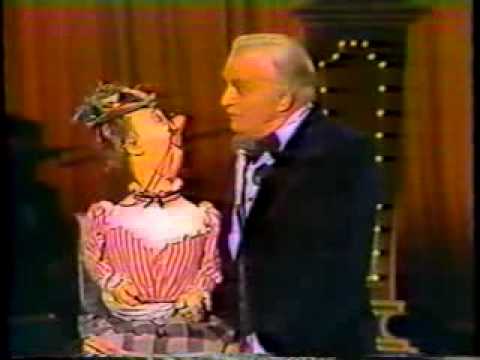 Edgar Bergen On HBO Show
-
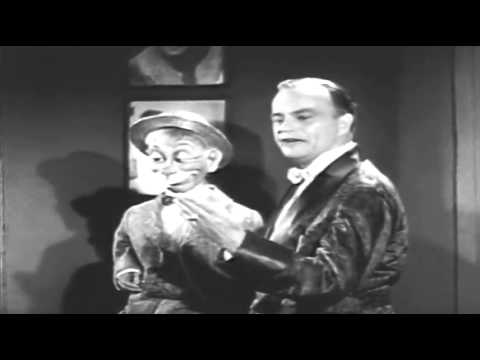 Edgar Bergen With Mortimer Snerd 1950
-
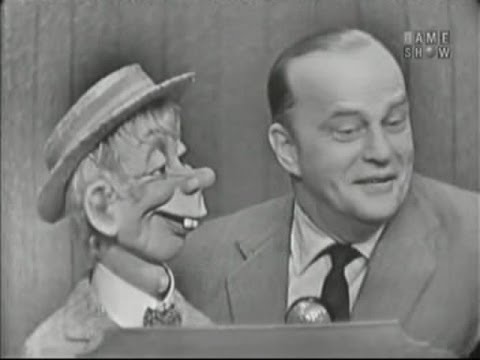 Edgar Bergen Paul Winchell On Whats My Line 1956
-
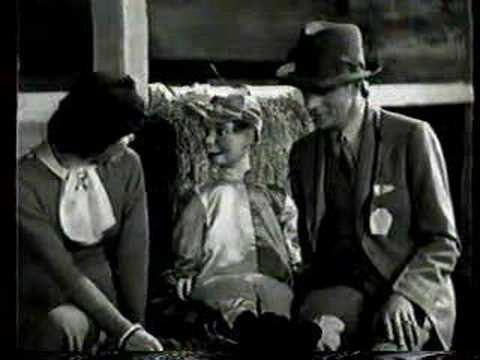 Edgar Bergen Charlie Mccarthy In At The Races 1934
-
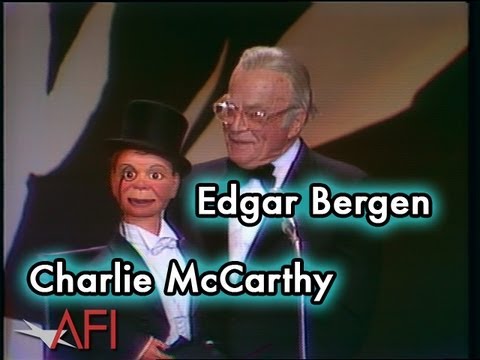 Edgar Bergen And Charlie Mccarthy At The Orson Welles Afi Life Achievement Award
-
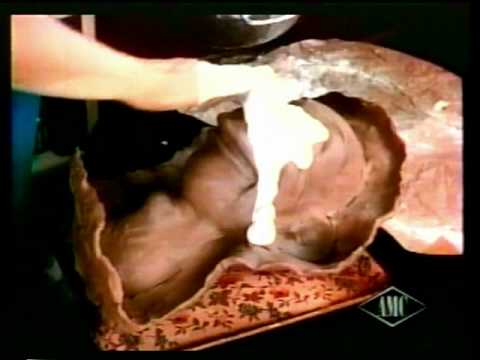 Edgar Bergen Charlie Mccarthy Creation Of Mortimer Snerd
-
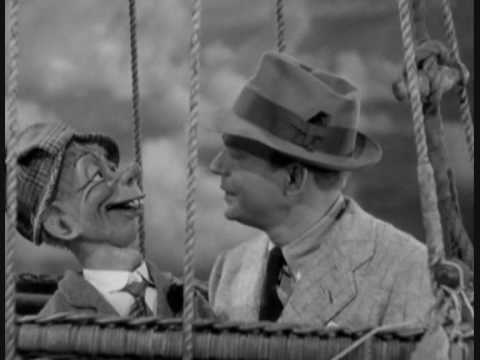 Edgar Bergen Mortimer Snerd In You Cant Cheat An Honest Man
-
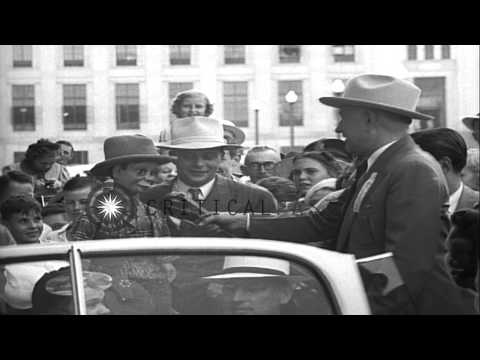 Edgar Bergen Charlie Mccarthy Interviewed
-
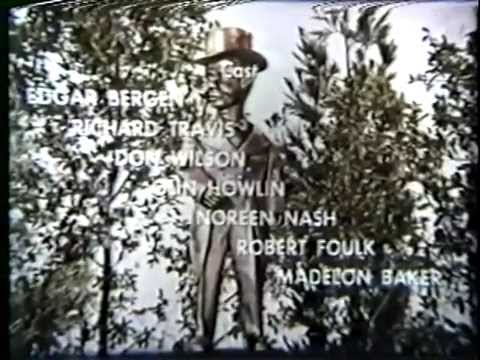 Edgar Bergen Charlie Mccarthy Charlies Haunt
-
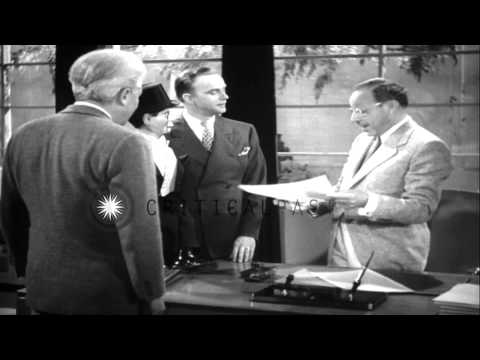 Edgar Bergen And Charlie Mccarthy Sign Movie Contracts
-
 Edgar Bergen At Graumans Chinese Theatre
-
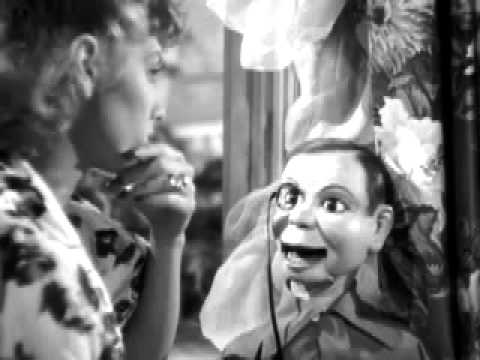 Edgar Bergen Uncanny Valley 1941
-
 Edgar Bergen Shriners Convention Sees Pageant Of Light
-
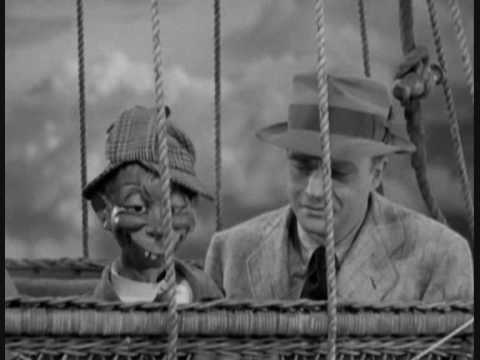 Edgar Bergen Mortimer Snerds Mysterious Ignorance
-
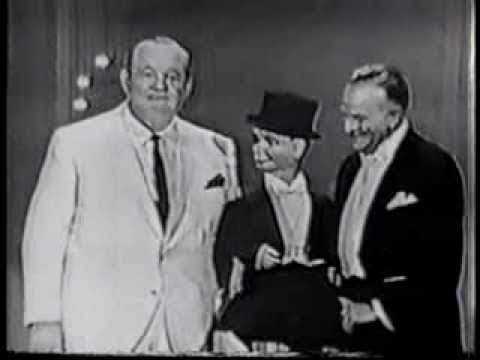 Edgar Bergen At Hollywood Palace
-
 Edgar Bergen With Podine Puffington
-
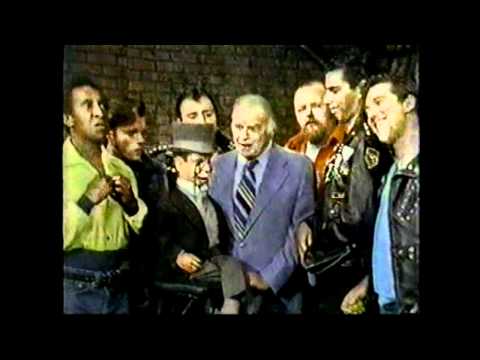 Edgar Bergen And Charlie Mccarthy With Sha Na Na Guest
Sources
- Ventriloquist.org, "The Living Art of Ventriloquism" (interest/news archive)
- Magicpedia (Genii Speaks wiki), "Edgar Bergen"
- Ventriloquist Central Blog, "Amateur Ventriloquist Production: Eddie in Decatur"
- Fathom.org, "Snerdville: Edgar Bergen," archived 2000, Internet Archive Wayback Machine
- Library of Congress, Chronicling America: The Waterbury Democrat, 14 May 1938
- The Oracle, International Brotherhood of Ventriloquists, January 1955
- Vent Haven Museum, gallery archive, Josephine Berger Memorial Building
- Ventriloquist Central, "Edgar Bergen and Charlie McCarthy" tribute page
- Library of Congress, Chronicling America: The Washington Times, 27 November 1937
- Ventriloquist Central Blog, "Esky, Charlie McCarthy and Ventriloquist Edgar Bergen"
- The Oracle, International Brotherhood of Ventriloquists, November 1954
- Ventriloquist Central Blog, "Top Hat for Charlie McCarthy"
- The Revival of Ventriloquism in America (Deutscher thesis), chapter "Edgar Bergen and the Revival of Ventriloquism," scanned document, Jimmy Vee collection
- Library of Congress, Chronicling America: The Evening Star, 16 September 1937
- Library of Congress, Chronicling America: The Evening Star, 17 October 1937
- Ventriloquist Central, newsletter, January 2012
- Ventriloquist Central Blog, "Ventriloquism and Choosing a Ventriloquist Figure"
- Associated Press, "Ventriloquist Dies at Age 75," 30 September 1978, scanned clipping, Jimmy Vee collection
- Mr. D's Blog (Clinton Detweiler), "The Wisdom of Peter Brough"
- Mr. D's Blog, "Feelings of Apprehension"
- Ventriloquist Central, "Ventriloquist Edgar Bergen: Short Subjects"
- Vent Haven Museum, gallery archive (gallery10-i)
- The Oracle, International Brotherhood of Ventriloquists, September-October 1959
- The Oracle, International Brotherhood of Ventriloquists, March 1957
- Ventriloquist Central Blog, "Ventriloquism and Marketing"
- Willinger Collection auction photograph, Session 2, Lot 163
- Ventriloquist Central Blog, "A Master Ventriloquist and His Other Interest"
- Library of Congress, Chronicling America: The Washington Daily News, 30 May 1938
- Ventriloquist Central Blog, "Charlie McCarthy Book Matches"
- Fathom.org, "Snerdville: Family," archived 2000, Internet Archive Wayback Machine
- Vent-O-Gram, "Mark Wade: The Interview," Parts I-II
- Find A Grave, Memorial #84, Edgar Bergen
- Vent-O-Gram, "Dennis Alwood: The Interview"
- Vent-O-Gram, "A Letter from Dick Weston"