

Some names in this family you say once and everybody nods. Paul Winchell is one of them. Jerry Mahoney. Knucklehead Smiff. Tigger. Say any of those out loud and somebody's grandmother lights up. But the man behind them was a stammering, polio-bedridden kid from Brooklyn who found his way out of his own body through a radio voice he couldn't even see the trick of. That's the story I want to tell you. So pull up a chair. Let me tell you about Paul.
A kid who couldn't talk, listening to a man who threw his voice
He was born Paul Wilchin on December 21, 1922, in Brooklyn.[1][2] He stuttered, and at five he came down with polio, put in bed for the better part of a year with his legs weak underneath him.[2] That's a rough hand for any kid. Here's what he did with it.
Confined to his room after a beating from his mother, a hard woman he later wrote was harder to negotiate with than God, he crawled toward the sound of a radio somebody had left on. "And now, the Chase and Sanborn Hour with America's favorites, Edgar Bergen and Charlie McCarthy." He had no idea what Charlie was. He figured he was just a boy like him. He sat on the floor enraptured, never realizing his life was about to change.[2]
His sister took him to Coney Island, where a wax museum had Bergen and Charlie standing frozen behind glass. "Ch-Charlie d-doesn't look v-very real," the boy said. "That's because he's a dummy, he's made out of wood," she told him. "Then how d-does h-he t-talk?" "Edgar Bergen throws his voice." His mother caught wind of the trip and came at him with a whip from her apron. He asked for a dime anyway, for a ten-cent booklet called How to Throw Your Voice. It was his sister's boyfriend, a young man named Cleve, who put the dime in his hand. "You can be whatever you want," Cleve told him. "I'll put money on it."[2] That is the whole hinge of a life, right there, in a stranger's ten cents.
Sixteen years old and already good enough for Frank Marshall
At fourteen he made a dummy head as a school art project and talked his teacher into class credit for it. He named the figure after that teacher, a man called Jero Magon, and that homemade schoolboy dummy is where the name Jerry Mahoney actually comes from.[3] His principal, seeing what the kid could do, sent him to audition for the Major Bowes Amateur Hour. He won first prize and went on tour with the traveling company, and along the way Major Bowes himself renamed him on the air: "his latest discovery, the amazing young ventriloquist, Paul Winchell." A stage name handed to a kid who still introduced himself as Wilchin.[2]
But the Jerry Mahoney the whole country came to know wasn't that homemade school project. It was carved by Frank Marshall of Chicago in 1938, for a sixteen-year-old Brooklyn boy who'd just gotten serious about the business.[4] And here is my favorite piece of the whole story. Marshall built Paul a custom figure first, and when Paul finally saw it he turned it down flat. "Well, sir, with all due respect, I can't use this," he told the maker whose client list read like the trade's who's-who. "Mr. Marshall, this dummy looks a little like me." Marshall just shrugged: "Well, I try to do that with all my figures. Put a little bit of the ventriloquist into the dummy." Paul didn't want to walk out empty-handed, though, so he grabbed a stock figure sitting in the shop that Marshall had named "Nosey" in his catalog. Paul did a little work on him, and that stock figure became Jerry.[5] One of the most famous faces on American television started life as a shelf model a teenager didn't want to leave without.
Twenty years, six shows, and a face on every kid's dresser
From 1948 to 1968, Paul Winchell held a spot on network television nearly without a break: The Bigelow Show, The Paul Winchell and Jerry Mahoney Show, Toyland Express, Circus Time, Cartoonies, and finally Winchell-Mahoney Time.[6] A 1950s NBC trading card put a hard number on what that meant: Jerry, "the sassier half of Winchell," was insured for ten thousand dollars while Paul was still actively working with him.[7] Carol Burnett, Lucille Ball, and Angela Lansbury all came through as guests.[1] Kids joined the Jerry Mahoney Club and got a membership card with a slot for their own photograph, placed right between pictures of Jerry and Knucklehead.[8] You weren't just watching the show. You were in the cast.
Winchell never stopped inventing, even at the workbench. He wanted Jerry to be more than a talking head, and the idea for what became "living arms" puppetry came from an odd afternoon at a veterans hospital in Atlanta, watching two one-armed patients work shoulder to shoulder, one man supplying the right hand and the other the left. He rigged up real puppeteers' hands inside the sleeves the same way, and during a boxing-skit rehearsal, when a prosthetic hand wouldn't fit the glove, an operator just pushed his own hand through instead. After that they used flesh-colored cotton gloves, and suddenly Jerry had fully articulated fingers, playing drums, tap-dancing, having a food fight with Knucklehead on Lucille Ball's own show.[3] Live television, a man and a puppet sharing the same frame like it was nothing.
The pal the fans demanded into existence
Here's a story I love. Jerry kept talking on the show about a friend of his named Knucklehead Smiff, a fellow who never actually appeared. The fan mail wanting to see him got so heavy that Winchell had to go build the guy.[9] A character willed into wood by an audience that had only ever heard him mentioned. Vent Haven Museum, which holds the original figures today, puts it plainly: Knucklehead's mouth was carved crooked on purpose, to show he wasn't as sharp as Jerry, and Winchell never gave him moving eyes for the same reason. Knucklehead called Winchell "Mr. Winkle," and his hair, like the real Knucklehead's, was only ever painted on.[10]
Who actually carved him is a question this family has argued about for years, and I'm not going to pretend it's settled. But the best account anyone's put forward, from a longtime figure dealer who studied the object closely, is a good one: Winchell had spare Jerry Mahoneys on hand, and he used one as the starting armature for Knucklehead, sculpting over it until the nose came out an inverted spoon shape and the mouth came out crooked. If that's right, then both halves of the old argument, "Winchell carved him" and "it's a Marshall underneath," are true of the very same figure.[11] And Winchell clearly kept trying his own hand at the craft long after: a basswood Knucklehead head, carved by Paul himself sometime in the 1960s, was never painted or finished.[12]

Started, never finished
A basswood Knucklehead Smiff head, carved by Winchell's own hand in the 1960s and left unpainted. He kept trying to make the face he'd once built by sculpting over a spare Jerry.

The carver's own hands
A pair of unfinished basswood feet, identified decades later by matching them to a 1952 Life magazine photograph of Winchell carving at his own bench.

Signed by the man himself
Vinyl Jerry Mahoney and Knucklehead Smiff hand puppets from the 1966 self-produced toy line, each signed on the body by Paul Winchell.

Later years
A vintage "Hollywood" collectible card pairing Paul with Jerry, from the years after the network shows had ended.
What the toy line remembers, in miniature
In 1966, Winchell walked away from Juro, the company that had been mass-producing his figures as toys, because he believed he could do a better, more realistic job himself. He put his own copyright stamp on the neck and sold the new dolls largely on the West Coast.[9] A Ventriloquist Central collector still keeping the actual 1966 toys in hand is as close as this corpus gets to holding them ourselves.


The doctor he never got to be
Here is the part of Paul Winchell most people never connect to the guy with the wooden partner. He held roughly thirty patents. In 1963 he patented one of the earliest artificial hearts, one that kept a calf alive for ninety-four days, and he donated it to the University of Utah for research. Years later, researchers there working in that same line, Dr. Robert Jarvik among them, became known for the Jarvik-7.[1] He'd always wanted to be a doctor. The Depression took that dream away from his family's budget when he was a boy, so at thirty-five he enrolled in pre-med at Columbia anyway, then went on to study and practice acupuncture and hypnosis.[3] He talked religion and theology for the same reason, working through his own depression by writing about it. Ask anyone who knew him what got him talking and they'll tell you: not ventriloquism. Medicine, and God.[13]
The tapes nobody thought worth keeping
Winchell-Mahoney Time ran from 1965 to 1968. Then Metromedia, the studio, got into a rights dispute with him over syndication, and rather than settle they erased 288 master tapes of the show. Three years of network television, a ventriloquist working to camera five days a week, gone on purpose as a bargaining chip.[6] Winchell sued. Everybody around him, lawyers included, told him not to. He went at it anyway and won a jury verdict of $17.8 million, the largest documented loss of ventriloquial performance footage this whole archive has ever come across, priced by a court and still lost forever.[5] In his own words: "All the work I had done in the past, there was no record of it. I felt that at last I'll have some remaining record of my work that future people could see, especially children. Suddenly, I didn't have it anymore. It was gone forever."[5]
A friend once asked him why he looked so happy up there with Jerry, whether the dummy made him as happy as he made the audience. Winchell didn't miss a beat. "No. Not at all," he said. "Because every time I was up there with Jerry, I was doing it for the wrong reason. I was trying to please my mother."[5] That's a hard thing to carry behind a grin that big for that long. I'm not going to smooth it over. Around here we love our people whole, complicated parts included.
The voice nobody knew was a ventriloquist's
When his own television show ended in 1968, a second career was already starting: he became the voice of Tigger in Winnie the Pooh, a job that ran for thirty-one more years, longer than his entire run as a television ventriloquist.[6] He won a Grammy for it in 1974, and it was Winchell himself, crediting his British-born wife, who came up with Tigger's signature "TTFN, ta-ta for now."[1] He went on to voice Dick Dastardly, Gargamel on The Smurfs, and Fleegle of the Banana Splits.[3] Most people who grew up loving those voices never once connected them to a man with a wooden partner named Jerry. That's the strange back half of ventriloquism's whole history: the medium that could show off the trick eventually just wanted the voice.
The circle
No performer works entirely alone, and Paul's world ran wide: the man who gave him his start, the men who came after, and the friends who carried him at the end.
Mark Wade, who ran the Vent Haven ConVENTion for years, put it about as fair as anybody: "Paul Winchell was a leading television pioneer. Great voices, great characters. I met him one time in Las Vegas. Nice man."[14] Nice man, from a peer who wasn't even a fan of his clenched-teeth technique. That's the kind of honest respect this family gives its own.
His last performance
By 2004 he'd had a stroke and could barely walk. He'd refused interviews about his own life for years, telling one biographer "you do the interview, you know more about me than I do," before finally sitting down with Kelly Asbury for the book Dummy Days. At the signing, packed with old friends, he didn't have Jerry or Knucklehead with him, only replicas. He grabbed one anyway, muttered that the levers weren't right, then called for Jerry Layne, the figure maker who'd built his own Jerry Mahoney replicas, and told him exactly how the bit would go. Paul could hardly walk, but he took command of the room like he always had.[5]
Jerry, in the bit, told Paul he looked different. Paul explained he'd had a stroke and couldn't see out of his left eye. "You mean you can't see the audience on your left side?" Jerry asked. "Yes," Paul said. Jerry leaned over, looked out at the crowd, leaned back, and delivered the last line of Paul Winchell's performing life: "That's OK. They're not worth looking at anyway." The room went crazy. That was his last show.[5]
Paul Winchell died at home in Moorpark, California, on June 24, 2005, at eighty-two, survived by his wife of thirty-one years, the former Jean Freeman, five children, and three grandchildren.[1] Jay Johnson, writing for Vent Haven as the news broke, drew the sharpest line anyone in this family ever drew between Paul and his own hero: "In the 1950s and early 1960s Edgar Bergen was an elegant legend, but Paul Winchell was an accessible friend. Such was the power of early television."[15]
A friend who knew him for years said he thought Paul went to his grave never really knowing how much he'd influenced. "Any of us could do it," Paul used to say. "It's nothing special." He was wrong about that, of course. Nobody else in this family turned down a custom Frank Marshall and made the shelf model famous instead. Nobody else got fan mail insistent enough to summon an entire character into wood. And nobody else in this whole archive held a patent for an artificial heart in one pocket and a ventriloquist's head stick in the other. He just never let himself see all three of those men as the same man.

A dime for a voice-throwing booklet, and history got Jerry Mahoney out of the deal. I have seen worse investments made on this trade, believe me.— Freddy Fiddlesticks, spokesdummy
Timeline
- 1938 — Won first prize on Major Bowes Amateur Hour, earning a touring spot with the Major Bowes Review.
- 1943 — First ventriloquist radio show with Jerry Mahoney.
- 1950-1954 — Hosted a prime-time NBC show under three titles: The Paul Winchell Show, The Speidel Show, and What's My Name?
- 1965-1968 — Hosted Winchell-Mahoney Time, his most successful show, written by wife Nina Russell.
- 1986 — Won a $3.8 million actual-damages and $14 million punitive-damages jury verdict against Metromedia for destroying the Winchell-Mahoney Time master tapes.
- 1963 — Received a US patent for a mechanical artificial heart implantable in the chest cavity.
- 1996 — Commissioned a new Jerry Mahoney figure from Tim Selberg to pitch a new series to Disney.
On video
-
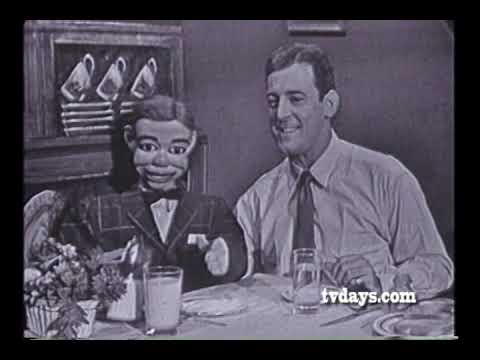 Paul Winchell Jerry Hanging Out At Home
-
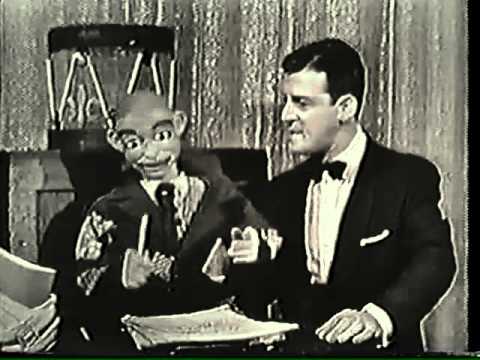 Paul Winchell Knucklehead Gets Fired
-
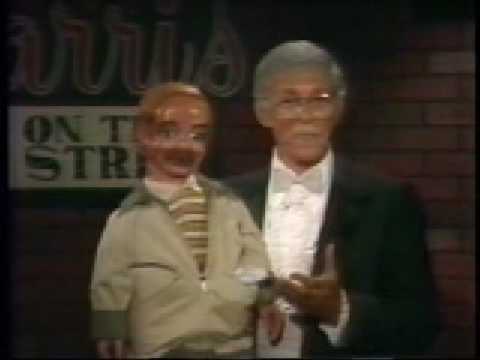 Paul Winchell Jerry Mahoney
-
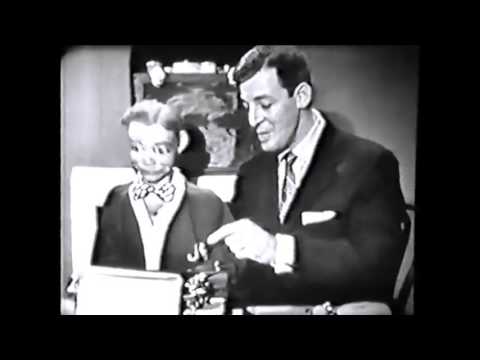 Paul Winchell Jerry Mahoney Knucklehead 1956
-
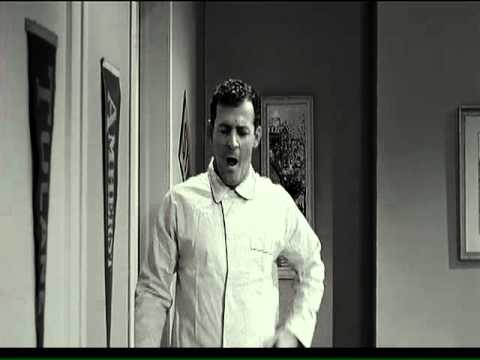 Paul Winchell Jerry Mahoney Time To Get Up
-
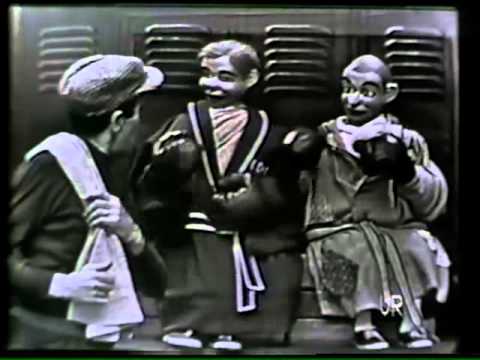 Paul Winchell The Boxers
-
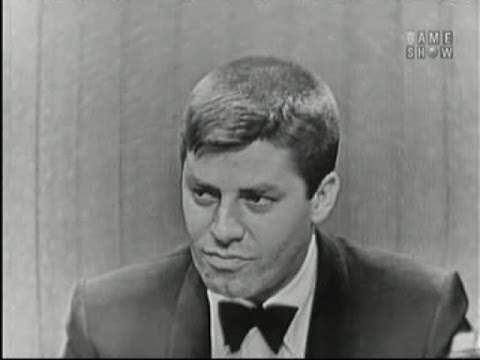 Paul Winchell On Whats My Line 1956
-
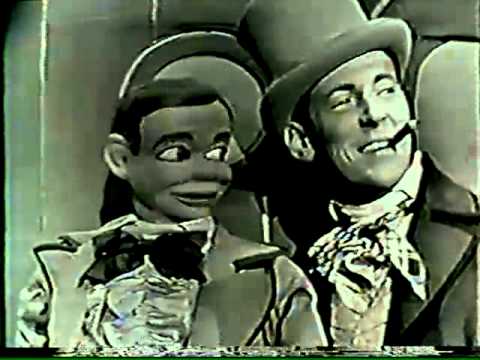 Paul Winchell Jerry Mahoney In 5 Card Studs
-
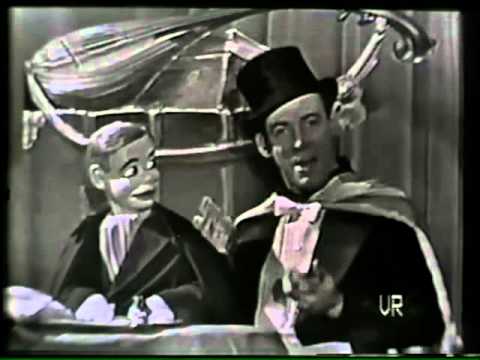 Paul Winchell In Winch The Magician
-
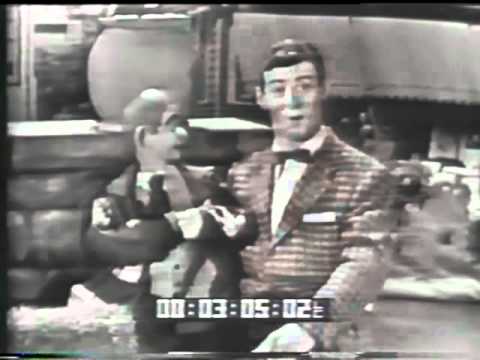 Paul Winchell Knucklehead In Smiff The Big Horse Song
-
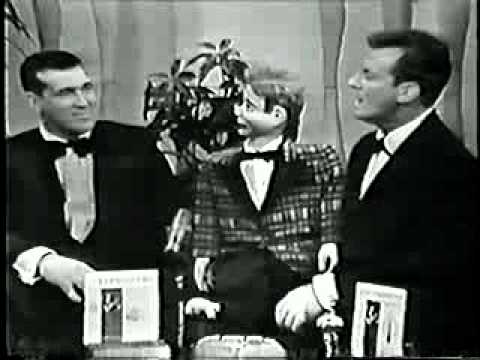 Paul Winchell In Laughs For Sale
-
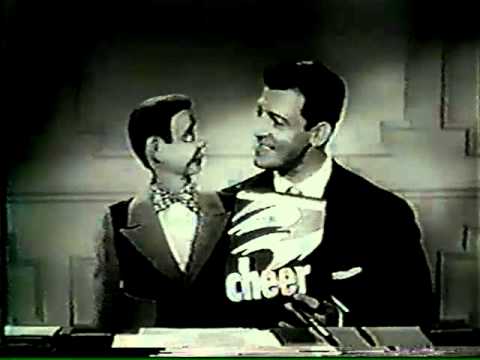 Paul Winchell Jerry Mahoney Rare Cheer Commercial
-
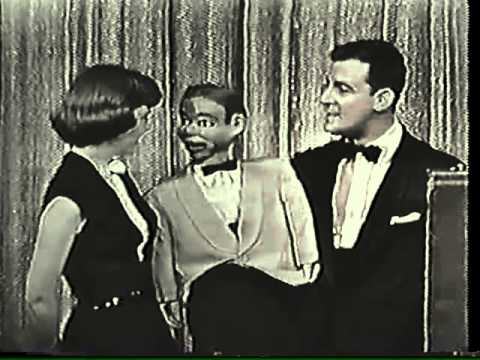 Paul Winchell Jerry Mahoney In Circus Time Season Finale
-
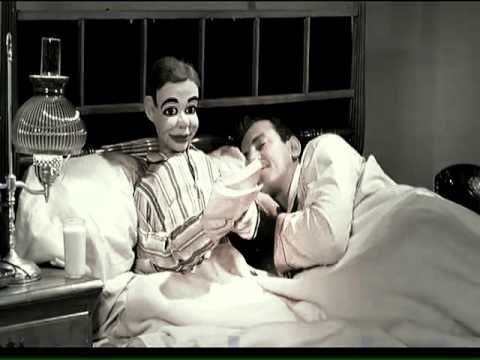 Paul Winchell With Jerry Knucklehead In Good Night Kids
-
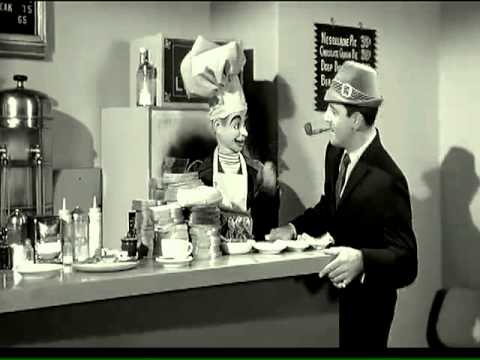 Paul Winchell With Knucklehead Smiff In Lunch With Knuck Youtube
-
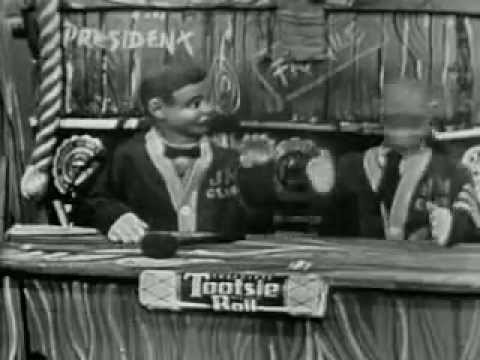 Paul Winchell With Jerry Knuck In 1955
Sources
- "Paul Winchell, 82; Ventriloquist, Character Actor, Prolific Inventor," Myrna Oliver, Los Angeles Times, reprinted in Newsy Vents No. 57 — scanned document, Jimmy Vee collection
- Distant Voices, Spring 2005, review of Winchell's autobiography Winch — scanned document, Jimmy Vee collection
- International Ventriloquist Society, Paul Winchell profile, and Steven Meltzer, "Paul Winchell," Ventriloquist Central
- Dialogue Magazine, Spring 1998 — scanned document, Jimmy Vee collection
- Burt Dubrow, interview, Vent-O-Gram
- Ventriloquist Central — Paul Winchell tribute, television chronology
- "Television & Radio Stars of N.B.C." trading card, Paul Winchell — scanned document, Jimmy Vee collection
- Ventriloquist Central newsletter, February 2013 — the Jerry Mahoney Fan Club
- Ventriloquist Central — ventriloquist toys tribute (Knucklehead created by fan demand; the 1966 Juro split)
- Vent Haven Museum — Figure of the Month, August 2005, Knucklehead Smiff
- Dan Willinger, "Comparing Jerry Mahoney & Knucklehead Smiff," Ventriloquist Central Blog
- Ventriloquist Central Blog — Winchell's carved items, matched to a 1952 Life magazine photograph
- Brad Cummings, interview, Vent-O-Gram
- Mark Wade, interview, Vent-O-Gram
- Jay Johnson, Vent Haven ConVENTion anecdotes, 2005
- Photo via Magicpedia, Genii Magazine's magic-history wiki (hero photograph)
- Photo contributed by Brian David Stevens via Find a Grave
- Photo via Potter & Potter Auctions, the 1966 signed hand puppets